Showing posts with label banana. Show all posts

Friday, March 16, 2012

The Discarded Portions, And What You're Missing


With certain foods, it's pretty commonplace to have a little scrap left behind.  Think of that yummy corn cob, or perfectly ripe banana, or absolutely delicious watermelon.  After a few pieces of each, your plate is littered with  cobs, rinds, and peels.  We don't think much of it, and usually toss our apple cores into the woods just like anyone else.  But what exactly are you throwing away?  Did you know that in certain cases, these "inedible" portions of food actually contain many nutrients that could do your body some serious good?  In fact, some may contain tons MORE health benefits than is easily fathomed.  And you know what?  Some don't taste so bad, either.

Watermelon Rinds:  This one you might have tried before, and you'd be happy to know that your instincts were correct in trying to munch away on this green nutrient goldmine.  In fact, the watermelon rind is actually healthier than the watermelon flesh, and though while it may not taste as good, consuming watermelon rind can give you a heaping load of beta carotene, vitamin A, citrullene (an important amino acid), lypocene, and vitamin C.  Now don't confuse the rind with the dark green outer skin, the rind we're talking about is the lighter green layer between the skin and the pink flesh.  The outer skin is a little harder to stomach (though I've definitely done it on several occassions.)  Next time you have a watermelon, feel free to keep chomping for just a few more bites, just to make sure you get a little of that very healthful rind.


Banana Peels:  You know, it's really only us humans who believe we're too good for a peel.  Many primates eat the entire banana, and by doing so gain a lot more of the fruit's total health benefits.  That's right, the peel, though slightly ropey and initially unappetizing, contains all sorts of goodies that your body will absolutely love.  They're rich with fiber, both soluble and insoluble, much moreso than the fruit itself.  This fiber can assist in raising good cholesterol levels and promoting healthy digestion.  Banana peels also have a significant amount of lutein, an important antioxidant.  Banana peels also contain a very large amount of potassium, a very crucial mineral which when balanced with proper sodium intake allows the management of bodily hydration.  To make banana peels a little more appetizing, wait until the fruit is very ripe, and the peel should be both thinner and slightly sweeter.  You can also boil or cook the peel, and many Asian cultures cook bananas IN their peel, and eat them as one total meal.  Cool, right?


Corn Cob:  OK, now seriously, who eats the cob of the corn?  Actually my loyal readers, I've done so on several occassions.  If the corn is boiled well enough, the cob is most definitely soft enough to consume, and doesn't taste half bad, in my opinion at least.  As far as health benefits go, I can't seem to find many on the internet, which means I must be a little bit strange to consume the cob.  However it's common knowledge that corn cobs can be ground up and mixed into cattle feed to increase fiber, so it's safe to say that the cob is extremely rich in fiber.  I can definitely agree with this, as they fill you up EXTREMELY quickly (one of fiber's most useful attributes, besides healthy digestion).  If you want to try a bite, I suggest you try eating the small end of the cob first, as it's likely to be the softest and most easily consumed. 


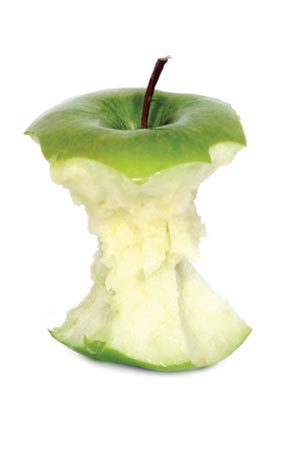
Apple/Pear Cores:  Some people just go all out, and don't let a single bit of their precious fruit go to waste.  Have you ever known someone who eats apple cores, or maybe the cores of pears?  I can tell you that I don't mind eating the core of a pear, however apples tend to be a little past what I can handle.  The seeds in apples are extremely bitter (which you've probably found out if you've accidentally eaten one) which is due to the fact that they're very mildly poisonous, containing a derivative of cyanide.  Don't worry, you'd need to eat a TON of apple seeds to actually poison yourself, but it's just something to keep in mind.  Feel free to eat the core of either fruit, just know that unlike banana peels and watermelon rinds, you're not consuming any sort of normally ignored health beneficiaries.  


Mushroom Stems:  For some reason, people like to throw away the stems of portobello and white button mushrooms.  Why is that?  The stems are just as tasty as the mushroom itself, and contain all the same health benefits, such as cardiovascular system support, anti inflammatory properties, antioxidants, and large portions of vitamins such as vitamin B2, B3, B5, and minerals like selenium, copper, and potassium.  Seriously, eat these things, they're tasty and great for you!


Peach Pits:  Just kidding...don't eat these...big choking hazard.

Avacado Pits:......Seriously? .........No.

So there you have it, a little look into the forbidden parts of food.  Some things you may want to definitely try out, a few others you can keep avoiding, knowing you're not missing much.  But don't worry, no matter what, as long as you're consuming the foods associated with these normally discarded portions, you're doing your body a whole bunch of good.  Eat up, and as always...

GOOD LUCK!

References:

Tuesday, March 6, 2012

The Banana: A Fruit For The Gym


When it comes to lifting, running, jumping, swimming, climbing, biking, or any other gym/workout related activity, all carbs are NOT created equal.  It's common knowledge that our body needs carbs to fuel it during intense activity, and carbs to refuel it after that intense activity has been completed.  Your body is like a high performance engine, which runs on carbohydrates.  Without that fuel, you're not going to get very far.  And with low quality fuel, you may be able to function, but just barely.  You'll end up misfiring and running rough more than making all the power you could, if you want to continue with the engine analogy.  There are many great sources of carbohydrates out there, most of which are natural and delicious.  You might think of oats, whole wheat bread, vegetables, or brown rice, just to name a few.  But all these are complex carbs, and while they'll fuel your body extremely efficiently in the long run, sometimes you need a faster digesting carbohydrate to really give you that kick in the seat of your pants.  I'm talking about sugar.  That's right, that dangerous thing that so many fitness enthusiasts avoid like the plague.  I'm here to tell you that not all sugar is bad, especially right before and right after your workout.  And where's a great source of healthy, natural sugar?  Why...fruit, of course!

But guess what, when it comes to working out, not all fruits are created equal, either.  Most fruits are comprised mainly of the sugar called fructose, which isn't bad for you, but isn't optimal for muscle glycogen fueling/replenishment.  In fact, fructose can only be used toward refueling liver glycogen, not muscle glycogen.  There are, however, a few fruits that are higher in glucose rather than fructose.  Glucose can easily be used by the body to refill muscle glycogen stores, so these fruits would be a much better choice pre and post workout.  And what's the most optimal choice as far as fruits go?  Why, it's America's favorite fruit, the banana!

I personally love bananas.  I recently added one per meal into my diet, just to increase carbohydrate intake.  They're delicious, nutritious, and do wonders for your body.  As mentioned above, a banana pre-workout can really give you an added energy boost as all the simple sugars are converted into immediate muscle energy, and post workout a banana is an excellent way to refill muscle glycogen.  The glucose in bananas both spikes your blood insulin to encourage muscles to "suck up" all the nutrients you're giving them, and replenishes muscle glycogen levels at the same time so you'll be ready and willing to hit the weights even harder tomorrow.  A good insulin spike after a workout is exactly what you want, which is why a banana paired with a whey protein shake is an excellent way to ensure proper recovery after a hard workout session.

And if you're already a fruit lover, and perhaps been curious as to their effects on your workout and recovery, but didn't really know which kind to pick, just know that a banana is probably your best bet if you want great results!


But good, natural glucose isn't the only thing bananas have going for them, oh no.  In fact, they're absolutely loaded with all sorts of other nutrients that will do you a world of good:

-Bananas contain a decent amount of your daily vitamin C intake, about 11%.


-They also have a large amount of dietary fiber, about 3.5 grams for one large banana


-Bananas have no fat or cholesterol, and therefore are an extremely healthy snack choice, especially if you're looking for a little energy boost.


-Bananas are rich with potassium (16% of daily intake), which is the forgotten electrolyte.  A balance of sodium and potassium can help your body remain adequately hydrated and energized, as well as ensure proper neural function (clear thinking.)  Many people consume an excess of sodium, but not nearly enough potassium.  Cut out the table salt, add a banana, and see how good you feel!  

Potassium replenishment is also extremely important after a workout, as you've usually drained a good amount of electrolytes from your body.


Here are the nutritional facts for a large banana:


Nutrition Facts
Calories 121(506 kJ)
% Daily Value 1
Total Fat0.4g< 1%
Sat. Fat0.2g< 1%
Cholesterol0mg0%
Sodium1mg< 1%
Total Carbs.31g10%
Dietary Fiber3.5g14%
Sugars16.6g
Protein1.5g
Calcium6.8mg
Potassium486.9mg


There it is, a little overview of my favorite workout fruit.  If your workout diet is lacking, add one or two bananas, as I did.  I can bet you'll see a huge improvement in your strength, stamina, and recovery.  Plus, they taste amazing, why wouldn't you want to have one?  And if you were merely confused on which fruit to choose for your workout goals, you can now feel secure in the fact that a banana will always be a better choice than an apple, a pear, an orange, etc, just because of its glucose-fructose ratio.  Cool stuff, right?

Keep on eating that magic yellow powerhouse!  GOOD LUCK!

Sunday, October 23, 2011

Sodium, Potassium, And Your Body

We all think we know a little something about salt (sodium chloride), and how it tastes darn good on that dinner of ours.  It can enhance the flavors of otherwise bland food, and can save some people from the dreaded plate of veggies.  And our body NEEDs salt to survive, because it cannot manufacture the nutrients in salt on its own.  You need sodium to maintain blood pressure, water levels, and to prevent dehydration.


However what we don't realize is that the average person these days takes in wayyy too much salt.  In fact, the recommended daily sodium intake is around 2000-2500mg, and many people can eat this number within two meals if they're big on processed food.  While you may not have realized this, and haven't ever really felt the effects of an overly large sodium consumption,  all that salt isn't doing your body any good, and in fact can be hurting you in some ways you might not initially see or feel.  However these little behind the scenes acts of mutiny can really come back to haunt you if you're desperate to lose a few pounds, or just get healthier in general.  Here's what excess an sodium intake can do to you:

Heart Health:  Excess sodium will most certainly raise blood pressure, because sodium has the job of regulating water levels in your blood.  The more sodium in your bloodstream, the more water is drawn into your veins, causing a higher blood pressure, and forcing your heart to work harder than it already has to.  And eating high sodium foods day in and day out will definitely take a toll on that oh so important chest muscle of yours.

Excess sodium can also wear down your kidneys, as it's their primary job to regulate the sodium in your bloodstream.  Too much salt can cause kidney stones, and in extreme cases, kidney failure.

A salty diet will also be very detrimental to any weight loss goals.  It will cause you to retain water, become bloated, and therefore you'll be unable to shed those last few pounds.  And because excess water appears like fat over your midsection, causing a soft, flabby look, I guarantee you won't be too happy with your appearance either. This water retention can be easily cured with a diet adjustment, but if you don't know what's happening, it may be very confusing and disheartening to wonder why that scale isn't budging, and those abs are still hidden.

Foods to watch out for:

Canned anything:  The general rule of thumb is to watch out for the canned stuff.  Yes, canned soup, canned vegetable, canned meat, fish, etc.  If it's in a can, it usually has a LOT of sodium in it, just to help preserve it for extended periods of time.  I'm guilty of the canned food craze, because being in college, I can't really keep a ton of perishable food and expect it to last long enough to eat it all.  I also happen to LOVE canned tuna, salmon, herring, etc (GREAT LEAN PROTEIN.)  But I never go crazy on the stuff, and the reason for that is the sodium.  One cup of canned soup can have as much as 940mg (or more) per serving, and there's usually two servings per can!  That's incredible, more than half your days sodium for lunch.

Chicken Breast:  Many chicken breasts and other frozen meats, though lean and fresh, tend to be injected with a saline solution to preserve them for a little while longer.  This excess sodium can add up if eaten many days each week, and before you know it you could be consuming much more sodium than you thought.  Wash your food before cooking to remove a lot of that salty mixture.


Fast Food:  I'll start this one off with a quote:

How do you know if you are getting too much sodium?
"If you eat fast food even once a week, you are probably eating 2 to 3 times as much salt as you need," says Jill Minette, R.D., assistant director of clinical nutrition at the Mayo Clinic in Rochester.


That's incredible.  Fast food is absolutely riddled with salt.  Just plain PACKED with it.  Salt adds a lot of flavor to very bland, processed food, so it's easy to see why fast food chains use so much of it.  One footlong sub from subway can have over 2700mg of sodium.  One Big Mac has 1040mg of sodium.  A Whopper has 1355mg of sodium.  A medium side of fries has around 300mg of sodium, however how often do you eat those without adding a packet of salt or two.  If you're looking to decrease sodium intake, fast food is definitely not the place to start.


Sauces:  A lot of sauces, like tomato sauces, salsa, hot sauce, mustard, chipotle, etc. have a large amount of sodium per serving.  I am a fan of salsa because of it's high flavor to low calorie ratio, but I know it's definitely not a good idea to go crazy on the servings I consume, just because of the large amounts of sodium per serving.  I still suggest sauces as a great way to add flavor to your food (certain healthier sauces of course, I'll give a list in a later article), but watch out for that salt.  Read the nutrition labels!

Any processed food:  Another reason why processed food is bad.  Salt is used for preservation and flavoring, and like I said before, the crappy processed food is what needs the most flavor to keep it selling.  Read the nutrition facts on that lunchable, that ramen (1500mg per block), or that lean cuisine.  Grab a banana or an apple instead and cut that sodium intake a little.


But excess sodium isn't the only problem.  Like I said before, our body needs sodium to survive, and without enough of it, we can easily become fatigued, dehydrated, and overall very inefficient.  Some people may not be consuming an overly huge amount of sodium, but are instead completely messing up the balance of sodium to water in their body.  I've now discussed the desirable amount of each (8-15 glasses a day of water, and 2000-2500mg of sodium), therefore this is the ratio your looking for.  If either one gets out of whack, you'll feel it.  You may feel dizzy, or even slightly sick if suddenly your sodium intake changes drastically.  Try to watch this ratio, keep it in check, and I bet you'll feel a lot better.

Unfortunately the water-salt ratio isn't the only ratio you have to watch in your body.  In fact, yet another problem with a great percentage of diets these days is that people aren't taking in enough of the other electrolyte, potassium.  In fact, some people take in very close the daily recommended dosage of sodium, but because they don't get enough potassium they still see the detrimental effects that a salty diet can bring on.   Potassium works side by side with sodium in your blood to regulate the acid-alkaline balance in your cells.  Basically, sodium works outside the cells, potassium works inside.  Without enough potassium in your diet there can be serious bodily effects such as poor brain function and an irregular heartbeat.  This is because without the correct amount of potassium in your diet, electrical signals to your brain and muscles are very inefficient.


Banana's are a food rich in potassium, try one today!

So here's my final advice.  Firstly, try to cut back a little on sodium.  Replace a few processed snacks with healthier, fresher alternatives, such as fruits and vegetables.  This will not only decrease your sodium intake, but will increase your potassium intake, and will better maintain that critical balance.  Also, drink more water, and while I suggest cutting your sodium, don't go ultra-low salt, because your body does need a regular intake of the stuff.  Keep your ratios in mind, and adjust your diet accordingly.

Keep balanced, stay healthy, and good luck!

Wednesday, October 19, 2011

Not Full Yet? Here's why


I'm going to go out on a limb and bet that once or twice your diet plans have been hampered by accidental overeating.  And while my most recent article explains why you shouldn't EVER feel bad about this, let's examine why it happens.

A big reason why people tend to overeat is because they don't feel full at the end of their meal.  They've just crammed down an entire can of Pringles, and within twenty minutes they're hungry again.  They're a little confused, but can't really fight their stomachs and end up eating more.  Probably another can, because the first one was so tasty.


But those were a lot of chips.  Why didn't they fill you up?  Or that entire soda, you could feel it in your stomach, but for some reason it did nothing to quell that ravenous hunger.  It's curious, isn't it, and I bet you'd like to get some foods in your diet that would really fill you up quick without actually consuming that much of it. But could such a food exist?

Of course they exist, and I bet you've eaten them and felt their effects without even realizing it.  Vegetables!  Seriously, vegetables will fill you up quickly with relatively few calories.  Try it some time.  Sit down to dinner sometime and pile a large heaping mound of veggies onto your plate.  Don't be shy about it, one cup of broccoli is something like 30 calories, and a cup of corn on carrots or peas is around a hundred.  Go ahead and eat three hundred calories worth of vegetables, and I can almost guarantee you'll be full for hours.  In fact, don't go overboard, because sometimes they fill you up faster than you'd think.  I've gotten stomach aches from eating too many vegetables before, not fun!


Why though, do these little super foods fill you up so nicely?  It's because they're high in FIBER!  Fiber is a remarkably brilliant little nutrient that does a lot of good things for you.  I plan to devout an entire article to it at some point, but for now we'll just say it helps keep your digestive tract in tip top shape.  Fiber is also indigestible by itself, so it makes your body work hard to move it through your system.  But in general, fibrous foods get you full faster, and keep you full longer.

Want more fibrous foods?  Grab an apple, a pear, a peach, or basically any other kind of fruit.  An apple is a great snack to fill you up quick if you get those afternoon munchies.  Fruit also has another added bonus, it's full of water, the greatest stomach space-filler known to exist!  Water will help keep you full by taking up room in that seemingly endless stomach of yours, and I guarantee you'll feel it.


Another great tip, if you're still hungry, before you go back for more food, drink a glass of water.  An entire glass.  Not only should you feel pretty full afterwards, but sometimes your body can get it's "hungry" and "thirsty" cries mixed up, and after some fresh water you may feel more satisfied than you thought.


So now it isn't a mystery anymore why those potato chips and that soda don't fill you up.  Potato chips are very low in fiber, and have high calories for the amount of food material that you consume.  That's a recipe for over eating.  And soda?  It's filled with High Fructose Corn Syrup and other cheap artificial sweeteners, which are designed not to spike your insulin levels as drastically, which, while that can be a good thing, also tells your brain that your body hasn't gotten enough nutrients, and that you're still hungry.

Try some fruits, veggies, and a glass of water.  Who knows, you might be full for hours.  Eat well, keep healthy, stay full.