Showing posts with label core. Show all posts

Friday, March 16, 2012

The Discarded Portions, And What You're Missing


With certain foods, it's pretty commonplace to have a little scrap left behind.  Think of that yummy corn cob, or perfectly ripe banana, or absolutely delicious watermelon.  After a few pieces of each, your plate is littered with  cobs, rinds, and peels.  We don't think much of it, and usually toss our apple cores into the woods just like anyone else.  But what exactly are you throwing away?  Did you know that in certain cases, these "inedible" portions of food actually contain many nutrients that could do your body some serious good?  In fact, some may contain tons MORE health benefits than is easily fathomed.  And you know what?  Some don't taste so bad, either.

Watermelon Rinds:  This one you might have tried before, and you'd be happy to know that your instincts were correct in trying to munch away on this green nutrient goldmine.  In fact, the watermelon rind is actually healthier than the watermelon flesh, and though while it may not taste as good, consuming watermelon rind can give you a heaping load of beta carotene, vitamin A, citrullene (an important amino acid), lypocene, and vitamin C.  Now don't confuse the rind with the dark green outer skin, the rind we're talking about is the lighter green layer between the skin and the pink flesh.  The outer skin is a little harder to stomach (though I've definitely done it on several occassions.)  Next time you have a watermelon, feel free to keep chomping for just a few more bites, just to make sure you get a little of that very healthful rind.


Banana Peels:  You know, it's really only us humans who believe we're too good for a peel.  Many primates eat the entire banana, and by doing so gain a lot more of the fruit's total health benefits.  That's right, the peel, though slightly ropey and initially unappetizing, contains all sorts of goodies that your body will absolutely love.  They're rich with fiber, both soluble and insoluble, much moreso than the fruit itself.  This fiber can assist in raising good cholesterol levels and promoting healthy digestion.  Banana peels also have a significant amount of lutein, an important antioxidant.  Banana peels also contain a very large amount of potassium, a very crucial mineral which when balanced with proper sodium intake allows the management of bodily hydration.  To make banana peels a little more appetizing, wait until the fruit is very ripe, and the peel should be both thinner and slightly sweeter.  You can also boil or cook the peel, and many Asian cultures cook bananas IN their peel, and eat them as one total meal.  Cool, right?


Corn Cob:  OK, now seriously, who eats the cob of the corn?  Actually my loyal readers, I've done so on several occassions.  If the corn is boiled well enough, the cob is most definitely soft enough to consume, and doesn't taste half bad, in my opinion at least.  As far as health benefits go, I can't seem to find many on the internet, which means I must be a little bit strange to consume the cob.  However it's common knowledge that corn cobs can be ground up and mixed into cattle feed to increase fiber, so it's safe to say that the cob is extremely rich in fiber.  I can definitely agree with this, as they fill you up EXTREMELY quickly (one of fiber's most useful attributes, besides healthy digestion).  If you want to try a bite, I suggest you try eating the small end of the cob first, as it's likely to be the softest and most easily consumed. 


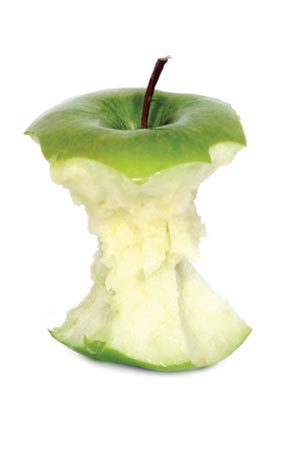
Apple/Pear Cores:  Some people just go all out, and don't let a single bit of their precious fruit go to waste.  Have you ever known someone who eats apple cores, or maybe the cores of pears?  I can tell you that I don't mind eating the core of a pear, however apples tend to be a little past what I can handle.  The seeds in apples are extremely bitter (which you've probably found out if you've accidentally eaten one) which is due to the fact that they're very mildly poisonous, containing a derivative of cyanide.  Don't worry, you'd need to eat a TON of apple seeds to actually poison yourself, but it's just something to keep in mind.  Feel free to eat the core of either fruit, just know that unlike banana peels and watermelon rinds, you're not consuming any sort of normally ignored health beneficiaries.  


Mushroom Stems:  For some reason, people like to throw away the stems of portobello and white button mushrooms.  Why is that?  The stems are just as tasty as the mushroom itself, and contain all the same health benefits, such as cardiovascular system support, anti inflammatory properties, antioxidants, and large portions of vitamins such as vitamin B2, B3, B5, and minerals like selenium, copper, and potassium.  Seriously, eat these things, they're tasty and great for you!


Peach Pits:  Just kidding...don't eat these...big choking hazard.

Avacado Pits:......Seriously? .........No.

So there you have it, a little look into the forbidden parts of food.  Some things you may want to definitely try out, a few others you can keep avoiding, knowing you're not missing much.  But don't worry, no matter what, as long as you're consuming the foods associated with these normally discarded portions, you're doing your body a whole bunch of good.  Eat up, and as always...

GOOD LUCK!

References:

Wednesday, February 29, 2012

Front Squats, And Why They RULE!

I've said time and time again, if you want to get stronger, faster, bigger, leaner, more powerful, and look like you actually lift weights, get under the bar and do some squats.  Seriously, you can read this article later! go hit up the squat rack for a few sets of heavy triples!


And now that that's done, let's talk about why next time you run off to the gym, you should try putting that heavy bar on your shoulders instead of your traps.  What the heck am I talking about?  FRONT SQUATS!  The ultimate total body squat exercise (save for overhead squats, though those can be a little harder to jump right into).  I'm not kidding, back squats and front squats are two completely different beasts.  To put it in perspective, I can easily rep 280 lbs for a set of three back squatting, then after a minute or two I'll be ready to come back and hit it again.  When I approach my max in front squats (which happens to be about 80% of my max back squat), I literally need to compose myself for quite some time between sets.  They absolutely drain you, and work your body to a whole new level of fatigue.  Don't be scared though, because after a set of good, deep front squats, you'll walk away from that squat rack feeling like you REALLY pushed yourself, and nothing feels better than that.

So what's a front squat look like?  Well, before I attempt to explain via text on a page, I'll show you a video:


This guy definitely knows how to front squat, great depth, great flexibility, and INCREDIBLE strength from the very rock bottom position.  Can you do this?  Absolutely, though obviously we'll start off with a little less weight.

First step in a front squat, approach and grip the bar with your hands slightly wider than shoulder width.  This will ensure your upper back is as tight as possible, and will fight your urge to "hunch" in the bottom of the squat.  Second, bring your elbows down under the bar, and push them forward until the bar is resting on your deltoids (shoulders).  Make it tight against your throat.  Don't worry about breathing problems, and if you are choking just a little, LOOK UP.  It will clear your airway.  I'm serious here, you want that bar tight against your neck, keep it close to you.

Now, un-rack the bar with either both heels under it or in a split position (just make sure you're not using your toes to lift the weight off the rack).  Step back with a couple slow, very controlled steps, and get your feet into a position that's either shoulder width or slightly wider (I go a little wider because I have very long legs).

Now this is important.  You may have learned to keep your legs parallel and your toes pointing straight forward.  If you do this in a front squat, you'll dump the bar.  Front squats require you to remain UPRIGHT in the bottom position, and therefore they might feel a little weird at first.  To accomplish this upright position, the first thing necessary is to point your toes at an angle slightly outward.  When it's time to descend, lock in your lower back, and instead of pushing your butt "back" like so many personal trainers might have told you, push your knees OUT and start to descend between your hips.  This may take time to get right, and you'll need to build up some hip flexibility to get it right.  STAY ON YOUR HEELS.  Don't go onto your toes, or your knees will punish you.  Keep going as deep as you can, continually pushing your knees out, and staying on the outside of your heels.  Once you're as low as you can go (hopefully at least below parallel), drive with your heels, quads, and glutes, and try to stay upright.  A little forward lean is expected under heavy loads, but try to keep it minimal.  Oh, and don't let your knees buckle inward!  Push them out with all your might!  Once you're standing again, feel free to do another.

Now I keep saying to remain upright, but I haven't told you two EXTREMELY important tips to doing so.  Firstly: KEEP YOUR ELBOWS UP!  Don't let them dip.  Keep them parallel to the ground (I mean your upper arm here, your elbows shouldn't point toward the ground at any time in the squat.)  Second:  FLEX YOUR CORE!!!!  Front squats are one of the greatest core exercises of all time BECAUSE they require you to keep your core extremely tight to stay upright.  You have to clench your abs with everything you got, even before you start the squat.  Don't even THINK about heading down until you make sure your abs are TIGHT.  The requirement for a strong core is much moreso than in back squats.

Here's a picture:


Alternate Grip:  If you're having trouble with the classic Olympic grip, you can try the cross arm grip.  You're still balancing the bar on your shoulders, but your grip looks more like one of those russian "hooplah" dancers, if you know what I mean.  If you don't, here's a picture:


I honestly don't like this grip too much, and if you do any sort of Olympic lifting, even as an assistance exercise, DON'T USE THIS GRIP.  But for those of you just starting out, or just doing front squats for the fun of it, feel free to try it out.  Some people like it much better.

So there's your intro to the front squat.  I HIGHLY HIGHLY HIGHLY recommend hitting this exercise ASAP! You won't be sorry.  The gains possible off of front squats are enormous, and a lot of people have found that if they've plateaued on back squats, front squats can push them over that stall point and keep their numbers going up.  As far as Olympic lifting is concerned, the front squat is MUCH more applicable to the lifts than back squats, because you're forced to stay upright (and every single time you clean a heavy weight, you have to front squat it up...see the relation).  Hit the gym and try these bad boys out and you'll look and feel like an absolute monster!

Squat deep, squat heavy, stay tight, and GOOD LUCK! 

Sunday, January 22, 2012

My Favorite Core Exercises


Have you ever wanted a rock solid midsection?  Abs that will break knuckles when punched?  Everyone does at one point or another, and I'm here to tell you that extreme core strength is quite attainable if you attempt to gain some.  The problem is, I think, that most people don't really know how to go about creating a core resembling the trunk of a tree.  They lay on the ground all day, crunching and crunching until they throw up.  Hey...GET OFF THE FLOOR FOR A SECOND and listen up.  There's quite a bit more you could be doing for your abs, especially if you're looking to get the strongest set you possibly can.

First, where is your "core"?  Well sure it involves your abdominal muscles, that plane of rectangular bricks just waiting to impress the ladies, but it also includes your obliques (on the sides), and even your upper quads and hip flexors.  And one part people often forget, it also includes your INNER abdominal wall (that's right, abs work both ways.)  To have a strong core is to be able to support yourself under the heaviest weights while maintaining good form and actually assisting the muscles required to lift said weight (like your legs).  These are all things I'm quite interested in, as should you be.  

First off, let's get one thing straight.  I'm talking about training core for strength, not definition.  You want rippling abs?  Let your diet take care of it.  Eat clean and under maintenance calories and you'll get a shredded midsection in no time flat.  Incidentally one of my favorite quotes is "train for strength, abs are made in the kitchen," (that's actually kind of a hybrid quote between some of my own analogies and Arnold Schwarzenegger's words.)  I hate to say it guys.  Crunches don't make you ripped.  Broccoli does.  Anyway, moving onward.  

Training abs for strength means high resistance, heavy loads, and intense reps.  You need to get that core used to contracting as hard as possible for as long as possible and sustaining that contraction no matter the cost or strain.  Sounds fun right?  Let's look at a few of my favorite high intensity ab contraction exercises.  

"L" chin-ups- These are my favorite by far.  They involve so many muscles I'd have a hard time counting them all, and they require extreme core strength.  I usually try to do at least 3-5 sets of these once or twice a week, after my squats.  Basically, get into chin up position, hold your legs at a 90 degree angle out in front of you (so your body looks like an "L"), and hold that angle as you complete as many chin-ups as you can.  Can't do chin/pull-ups?  No worries!  You can also do an "L" hang.  Just hang from the bar, hold your feet out in front of you, and count to ten.  Rest, then do it again.  I guarantee you'll feel a burn in this one, and it's an incredible core strength builder.  


"V"-ups- Whoa, another letter name exercise!  You've probably seen these before.  The key to these is keeping it slow and controlled.  Basically, lie flat on your back to start, with your arms overhead.  Slowly raise your feet while keeping legs straight, while at the same time raising your hands and arms to match the plane creating by your legs.  When your arms and legs are parallel, crunch toward your toes (touching them if you can), then descend back to starting position SLOWLY.  DO NOT LET YOUR FEET OR HANDS TOUCH THE GROUND.  Keep the contraction the entire exercise.  Do as many good reps as you can, take a short break, then come back for some more.  These are nuts.  


Plate/Russian Twist Balance- Want some serious pain?  Try these suckers.  Hold a plate in your hands (I'd recommend starting off with a 5lb or 10lb plate), and sit narrow-ways on a thin bench (such as a bench press or adjustable bench).  Raise your feet up and lean back so you're balancing on your butt, and hold the plate over one side of your body so it is almost touching the bench.  In a rapid but controlled and CONSTANTLY contracted motion, twist the plate across your body to the other side, ALMOST touch the bench, and repeat.  After twenty to thirty to a gazillion reps of these your core will feel like jello, I promise.  Because you're constantly contracting the core, it gets used to a heavy strain for extended periods of time, building some serious strength.  


The guy in this video taps the plate on the ground.  You CAN do that, but I believe that stopping the motion BEFORE the ground does requires a little more work on your core's part.  Up to you.

"Super Slow" Decline Sit-ups- In truth, doing any core exercise "super slow" is a great idea, as it forces your core muscles to remain firmly contracted for longer periods of time, lending itself toward great, useful strength gains.  This one is just what it sounds like. Hop on a decline bench, and start doing some damn slow sit-ups.  On the way down, stay very slow and controlled, count in your head if you have to.  Go very deep, trying to feel even your lowest abs, and DON'T let your back rest on the bench.  Start your upward movement just before your upper back touches the bench.  This means you'll need to stay quite upright, no hunching forward like you see all those other gym nothings do.  Slow and controlled, firm, contracted, and upright.  Do 15 reps per set, and you'll be burning all day.  

Want an even better burn?  Hold a plate or dumbbell over your head while you do these.  CRAZY!


This is the best video I could find in regards to FORM, but I have no idea why they call it an incline bench when it's clearly at a decline...

Front Squats-  Whaa???  Front squats?  I must've been crazy when writing this and accidentally included a leg exercise.  WRONG.  Front squats are still probably the greatest core workout I regularly do.  To front squat, you must hold the bar on the front of your deltoids, and to avoid dumping the bar in the deepest of bottom positions, you must remain as upright as possible while in the hold.  With all that weight pressing down on you, guess whose job it is to help keep you upright?  That's right!  Your core.  The heavier the squat, the more work your core does.  Try these out sparingly at first, and make sure your form is good.  I'll bet you'll see what I mean though, and quickly.


So there you have it, a few of my favorite core exercises geared toward creating massive core strength.  Do these on a consistent basis and I guarantee that when you get around to dieting down to low body fat percentage you'll have a midsection to be truly envious of.  

Keep it heavy, slow, and controlled.  Good luck!

Sunday, October 30, 2011

The Ultimate Movement

This is a Knol I wrote a while ago, and was quite proud of it.  I suggest learning the overhead squat if you are able, as it will do you a World of good.

The Ultimate Movement

Exploring the Benefits of the Overhead Squat

In truth, there is no one "greatest" exercise to perform. Not for strength, endurance, flexibility, nor any other subset of the fitness world. However, there are a few that can produce great results in most of these fields. This article will discuss one of my personal favorites: The Overhead Squat, and why exactly it can transform someone into a very strong, flexible, powerful individual.

The overhead squat, by nature, is a scary sounding exercise.  It can be even more daunting to watch, as someone who's never seen/tried one before will find it very hard to understand how one can hold such huge amounts of weight over their head, then descend beneath it into the deepest, most straining of squats, and rise back from the depths to full standing height, miraculously unharmed, shoulders and legs fully intact.

Ben Smith demonstrating the overhead squat


Without doubt, this exercise is difficult.  It is strenuous, and requires vast amounts of strength, stability, and flexibility.  And with higher weights, the term "vast" becomes more and more of an understatement.  But even at very low weights, this movement remains one of the greatest full body exercises one could ever do in their routine.  It engages muscles everywhere, and therefore will build complete, full body strength.  To figure out one movement can do so much, let's examine the overhead squat piece by piece.

It should be mentioned first that any type of weighted squat will do wonders for building remarkable strength.  Why is this?  Well, squats require the activation of a huge amount of muscle fiber in order to complete even one with good form.  You may think of squats being synonymous with leg workouts, and while this is initially a correct instinct (a good squat will activate the hamstrings, glutes, and quadricep muscles), they activate many more muscles as well.  In fact, to be stable in a deep ATG (ass to grass...pardon my french...) squat requires an extremely strong core.  Core in general means muscles in, you guessed it, the MIDDLE of the body.  This includes abdominal muscles, upper legs, lower back, and obliques.  More formally, it is defined as the entire spine, pelvic girdle, and hip joints.  This is a remarkable 29 muscles at least!  That's a LOT of muscle fiber.  And the best part of all this?  All that huge amount of muscle fiber is actually USEFUL.  The muscles you're activating while squatting are some of the most used in the majority of other strength related exercises.  So when you squat, you build real, usable strength, everywhere.  

A second, equally important reason as to why squats are so important may be of interest to those guys looking to get bigger and more muscular quickly.  Because squats activate the largest muscles your body possesses, as you squat you release a large amount of testosterone, which will cause your body to go into, put simply, "muscle building mode." You'll pack on lean mass relatively quickly (obviously not that quickly, building lean muscle take a LOT of time), and the strength gains will be as close to immediate as you can get.  Ladies, don't be scared by the word testosterone, squats will only help you, as will all weightlifting.  In fact, adding any muscle mass will increase your metabolism and help you shed unwanted pounds.  And you will NOT bulk up.  I don't care who says you will, they are wrong.  Go look at any female Olympic weightlifter in the lighter classes.  They're throwing 300lbs above their head, and they're still lean, mean, sexy machines.  

On an aside, SQUAT DEEP.  Parallel squats are what hurt your knees, as they take the brunt of the force as you go from descending to ascending.  As you go below parallel, that same force is transferred to your hips and hamstrings, which are bigger muscles that can definitely take the strain.


Well there's the squatting portion of the exercise.  And talk to anyone who know's squatting, it's not easy.  People spend years developing good squat form (not to deter anyone from trying, I suggest it to anyone and everyone looking to put on a little muscle).  But with the overhead squat, squatting is really only half the battle.  The other portion is obviously making sure that the huge weight above your head, doesn't come crashing down from it's precarious perch above your head.  This requires even MORE strength.  A lot more.  

To hold the weight overhead, there's generally a specific grip used.  It's called the "snatch" grip, and is named after the Olympic lift (the snatch) where athletes bring the weight from the ground to overhead in one fluid motion, catching it in...you guessed it...a full overhead squat.  There's a reason those athletes are considered the strongest in the world.  The snatch grip itself means to hold the bar with one's hands very spread apart, nearly at the collars of the bar.  

  This requires less shoulder flexibility to remain upright and "tight" in the bottom of the squat.  The narrower the grip, the more shoulder flexibility is required to go ATG.  This is because as you descend, your shoulders must rotate backwards in order to keep the bar aligned over your heels, and in turn keep your entire body balanced.  Drift too far forward or backwards, and you'll be forced to dump the bar.  What this basically describes is an extremely tight isometric exercise for your entire upper back, core, shoulders, and chest.  One must keep their traps squeezed together and their arms locked out throughout the entire motion.  This, without doubt, becomes very fatiguing VERY quickly.  Little tiny bits of bar movement suddenly require huge efforts to fight and contradict.  And after a few sets, it's almost a guarantee you'll be sore the next day where you haven't ever felt sore before, because most likely you've never worked stabilizing muscles to such a high degree.

    To even do one overhead squat, with any sort of weight, is an accomplishment.  No one should claim it's not, because it'd be safe to say the large majority of gym-goers have ever ventured from their routines enough to try one.  The flexibility requirements of overhead squatting is large.  One must have very flexible hips, knees, hamstrings, calves, quads, shoulders, chest, and spine.  Luckily the overhead squat itself is not inherently possible without such flexibities, so the risk of strain or dislocation decreases.  One who isn't flexible enough, will be forced to drop the bar before any sort of bodily damage can occur. 
     In order to increase flexibility for such an exercise, many stretches should be done on a daily basis (perhaps this is a good time to say that this article is merely meant to describe the benefits of overhead squatting, and should not be considered a guide to either the exercise itself or the supporting exercises or stretches.)  And not only will stretches help your overhead squat, the overhead squat itself is an amazing full body stretch, and therefore will only help you to become stronger and more flexible in the long run.

So is it the Ultimate Exercise?  Is overhead squatting the greatest, most beneficial movement one could do in the gym?  Again, certainly not exclusively.  But the benefits associated with the exercise are immeasurably large, and definitely place this exercise near the top of the list.


Talk to Marcin Dolega, champion 105kg class Polish weightlifter, about the benefits of overhead squatting.  That's a full Olympic snatch^^^....and is about 400lbs.