Let me tell you a little story about me, and fish oil. About two weeks ago, after a seriously heavy squatting session, I walked back to my dorm with burning hot knees, feeling like they were on fire every single time the ligaments moved at all (which they were doing quite frequently while walking...surprise surprise.) I knew it was every Olympic lifter's nightmare: patellar tendinitis. This is where the tendons across the front of the knee (the patellar tendon and surrounding tissue) become inflamed and swollen, and therefore are very resistant to sliding smoothly like they should. The cause? Overuse. It's a quite common injury among lifters, as well as runner, jumpers, and any athlete who runs, jumps or squats day in and day out. For an Olympic lifter, it can be extremely depressing, as it means that future squatting sessions will be full of pain and misery. And taking time off from training unfortunately ISN'T an option. Any time not spent under the bar is progress lost toward new PR's, podium placings and gold medals. Patellar tendinitis isn't dangerous, just VERY uncomfortable and debilitating.
So what did I do? At first, I started ice massage, which helped a little, but never seemed to make any progress in the grand scheme of things. Every workout after that was pain and suffering just as bad as before. So I did a little more research, and through countless hours of internet searching I found what I hoped to be a possible cure: Fish oil.
I read that Olympic weightlifters, when faced with patellar tendinitis, often go on a mega dosing fish oil regimen. That called for 5000 mg a day for the first week, and an additional 2500 mg a day ever week after that. I read that the condition should improve noticably in 10 days, and be almost gone by day 30. I figured it couldn't hurt, and so I picked myself up 300 caps of 1000 mg fish oil pills. The very next day I started in on 5 pills, spread throughout the day. Well my friends, it's been ten days, and I'm pleased to tell you that my knees feel SOOOO much better.
Sure, I kept icing, massaging, stretching, and foam rolling, but I have absolutely zero doubt in my mind that fish oil is a nearly "magic" cure for joint pain. If you don't believe me, just read the countless testimonies by other happy consumers who have loosened up and feel tip top thanks to a pill filled with oil from a fish. But after I started dosing, I did some reading on the pills. Turns out fish oil is far more beneficial than I ever could have imagined. Honestly, I would recommend EVERYONE get on fish oil pills, because what they do to your body is absolutely astounding. Let's look at these magic capsules a little more closely, and really see what I mean about their truly remarkable power at improving your health and well being.
Omega-3: A lot of the magic in fish oil pills comes from this substance right here, omega-3 fatty acids. This stuff is like liquid gold. It's probably some of the best cardiovascular support you could ever get, and will lower bad cholesterol considerably if regularly dosed. It also acts as a strong anti-inflammatory, which helps bloodflow, joints, and pretty much everything else in your body work smoothly and pain free. There are a few types of omega-3 fatty acids: EPA, DHA, and ALA. The two most biologically available and important of these are EPA and DHA, and both are found in significant amounts in fish oil. ALA isn't as important in our body, and can be found more often in flax oil. These are called "essential" fatty acids because our body cannot produce them on its own and yet requires them to function. That's why fish oil supplements are an extremely good choice, especially for those who don't get much fish in their normal diet.
On a side note, in order to achieve maximum health status, you need a good ratio of omega-3's to omega-6 and omega-9 fatty acids. The two latter are often found in other fatty foods such as nuts and seeds, and therefore we usually get plenty of them. However omega-3 fatty acids are usually lacking in the average individual's diet, and therefore it's very important to supplement fish oil.
Decreased Stroke Risk: Strokes are caused when plaque builds up in your veins to the point where it begins to break off and cause a clot in your brain's blood vessels. That's NOT good. Luckily, fish oil has been proven to break down the plaque in your veins, drastically decreasing the chance of suffering from a stroke. I'll take that and run with it, thank you very much.
Improved Mental Health: Fish oil has actually been shown to support proper levels of serotonin production in the brain, which will help treat/prevent conditions such as depression. It has also been shown to aid in memory and overall cognitive ability. I think that's awesome, don't you?
Healthy Skin: Fish oil has been proven to improve the health of your skin, allowing for greater elasticity through optimum collagen production. It'll keep you looking young and wrinkle free. I'm not saying it works miracles, but hey, healthy skin is always a nice thing to have, don't you think?
Fat Loss: Haha ok, I'll go into a little more depth on this one, as I can guarantee it'll peak the interest of a few more people. Fish oil is an EXCELLENT tool for fat loss, and I'd say it's essential for anyone wanting to see real results as quickly as possible. Fish oil increases the production of leptin, which both increases your metabolism and decreases your appetite. A faster metabolism means more fat burning power, something many people would absolutely love. Secondly, fish oil is able to increase insulin sensitivity, which allows your body to release less insulin when it senses ingested carbohydrates. This ensures that you'll be less likely to store excess carbs as body fat. Thirdly, fish oil actually helps build lean muscle mass, which will also increase your metabolism and cause your body to hold onto less body fat. Fish oil, despite being 100% fat, actually is probably one of the most powerful fat loss tools you could ever have in your arsenal. Cool huh?
Joint Health: OK, I saved this one for last because I've already sort of discussed it. Fish oil is one of the best tools out there for maintaining healthy, pain free joints. Its anti-inflammatory properties keep things sliding smoothly, and hey, the slippery properties of oil don't hurt either. Thousands upon thousands of people have obtained amazing pain reducing effects from dosing fish oil on a regular basis, and if you think it's too good to be true I IMPLORE you to give it a go for yourself. You'll be very surprised at how effective this stuff is.
Fish oil has been touted as the only supplement worth taking. While I don't completely agree with this, I do agree that it is almost 100% necessary for any serious gym-goer, casually active individual, or couch potato. Seriously, this stuff will do you nothing but good. If you don't believe me, try it for yourself. Pick up a bottle, start your dosage at 3 a day, and see what changes start to occur in your body. I can almost guarantee you'll love this stuff as much as I do by the time you're done.
Love the fish, keep healthy and happy, and as always, GOOD LUCK!
References:
http://www.livestrong.com/article/315158-the-truth-about-fish-oil-fat-loss/
http://orthopedics.about.com/cs/patelladisorders/a/patellartendon.htm
http://fishoilbenefitshq.com/
http://www.webmd.com/healthy-aging/omega-3-fatty-acids-fact-sheet
This blog will inform you about all kinds of food. It'll teach you to make the right choices, and feel great about them. By making these choices I personally guarantee you will perform better in the gym, stay healthier throughout the year, and get stronger both physically and mentally. I might even give you a few recipes to try. And on top of all that, I promise it'll be fun to read =].
Showing posts with label benefits. Show all posts
Friday, April 27, 2012
Saturday, April 21, 2012
The Cooking Oil Guide
When it comes to throwing that fillet on the skillet, or frying up the tastiest stir fry this side of the moon, you're going to be using a little bit of oil in that hot, hot pan of yours. I'm here today to tell you that not all oils are created equal, and while sure, any one of them might give you a nice browned fish or seared chicken, some might actually detract from the health factor that's inherently in the foods you're choosing. Let's make sure you make the right choice when it comes to choosing an oil, OK?
In terms of your choices, they're actually quite varied. Oils tend to be very high in calories due to their dense fat content, so as far as calories go, you definitely want to get the most bang for your buck. So let's get started, and see which cooking oil might best suit your next meal:
Canola Oil: When it comes to cooking in oil, you'd do well to avoid canola oil, despite it being cheap. While it is very rich in polyunsaturated omega-6 fatty acids, it's an EXTREMELY processed oil that's formed through intense chemical processes. It's basically an industrial product, and was actually initially intended for usage as a machine lubricant. As you probably know by now, processed foods can do some serious harm to your body, and while I don't believe canola oil will destroy you single handedly, there are definitely quite a few healthier choices out there.
"Generic" Vegetable Oil (Soybean Oil): Generic "vegetable oil" is kind of hard to define as one specific oil, but for the most part it's considered refined soybean oil. When I say refined, that means, you guessed it, it's processed. In fact, most generic vegetable oil is along the same lines as processed canola oil, in that the polyunsaturated fats it contains are in general too processed and "rancid" to actually be healthy for you. They're not along the same lines as healthy polyunsaturated fats that come out of nuts, seeds, fish, and other similar foods. Is vegetable oil unhealthy? Not disgustingly so, but like I said for canola oil, there are better options out there.
Olive Oil: Ah, here we go, the original "healthy" oil. Olive oil is extremely good for you, in that it contains unprocessed, natural, healthful monounsaturated fats, and tons of antioxidants and polyphenols to boot. Olive oil is great to fry in, especially extra virgin olive oil. It has a remarkably delicious flavor that can be a fantastic addition to many dishes, and in my personal opinion is one of the best tasting oils out there. The only downside to olive oil is that it has a relatively low smoke point, and therefore will burn in a pan over 350 F. With extra virgin olive oil, you can avoid this problem somewhat because it has a smoke point of a little over 400 F.
Sunflower Oil: If you haven't tried sunflower oil before, I would definitely suggest doing so. It's extremely good for you, very tasty, and very easy to cook with. It's very high in vitamin E, and contains huge amounts of mono and polyunsaturated fats that are unprocessed (and therefore healthy for your body.) There are three varieties of sunflower oil, high oleic acid, linoleic acid, and NuSun. Depending on which type you get, you'll get different amounts of omega-3 and omega-6 fatty acid ratios, but in general you can't go wrong with any of them. If you have to choose though, go with the NuSun variety, as it is the least likely to form harmful trans fats when heated.
Peanut Oil: This is a tasty oil if you enjoy nuts. I love the taste of peanuts, and therefore a little nuttiness in my food is most welcome. Peanut oil is another natural, healthy alternative to processed oils, and is very high in monounsaturated fats and polyunsaturated, omega-6 fatty acids. It also has a very high smoke point which means it can be used in recipes requiring high heat. For the most part, peanut oil is also cheaper than olive oil, so it's a more economic choice for the average health oriented person. It will impart a little of the nutty flavor into the foods you're cooking, but in my opinion it's quite an enjoyable flavor.
Macadamia Nut Oil: This is a very interesting cooking oil, and in some ways a very "exotic" option for frying your food. It's an extremely healthy natural oil, with not only huge benefits from monounsaturated fats (like almost every oil here), but also from containing large amounts of antioxidants such as squaline. It also contains high amounts of vitamin E, a necessary addition to any healthy diet. It can also help lower cholesterol due to its healthy fat profile (well, so can almost every oil mentioned, but I had to say it somewhere, right?)
Coconut Oil: This oil is a little bit different from all the rest, in that it DOESN'T contain many unsaturated fats, and in fact is comprised of almost 90% saturated fats. Don't worry though, this doesn't mean the oil is unhealthy. In fact, coconut oil is one of the healthiest oils out there. It has a high composition of lauric acid, a powerful antioxidant that is also very heart healthy and supports your immune system. Coconut oil, despite being high in saturated fat, can also help to LOWER bad cholesterol. It's also quite tasty and can add an exotic flair to any stir fry. Coconut oil is blatant proof that not all saturated fats are bad, and that they don't deserve the devilish reputation they've been given.
Hopefully that list gave you a little bit better idea of what exactly to look for when buying oil. In all honesty, it's hard to go wrong when choosing a cooking oil, so don't stress. Even canola oil, while processed, won't degrade your health, you just won't be getting some of the fantastic nutritional benefits available in other, more natural cooking oils. Switch it up a little bit, try a new oil every time you get a chance, I guarantee they can really make your meals quite interesting, flavorful, and add a whole new layer of health benefits.
Keep that pan oiled, and those veggies sizzling. Good Luck!
Labels:
benefits,
best,
calories,
canola,
coconut,
cooking,
extra,
fat,
healthiest nutritional,
monounsaturated,
oil,
olive,
peanut,
polyunsaturated,
sunflower,
vegetable,
virgin
Friday, March 16, 2012
The Discarded Portions, And What You're Missing
Watermelon Rinds: This one you might have tried before, and you'd be happy to know that your instincts were correct in trying to munch away on this green nutrient goldmine. In fact, the watermelon rind is actually healthier than the watermelon flesh, and though while it may not taste as good, consuming watermelon rind can give you a heaping load of beta carotene, vitamin A, citrullene (an important amino acid), lypocene, and vitamin C. Now don't confuse the rind with the dark green outer skin, the rind we're talking about is the lighter green layer between the skin and the pink flesh. The outer skin is a little harder to stomach (though I've definitely done it on several occassions.) Next time you have a watermelon, feel free to keep chomping for just a few more bites, just to make sure you get a little of that very healthful rind.
Banana Peels: You know, it's really only us humans who believe we're too good for a peel. Many primates eat the entire banana, and by doing so gain a lot more of the fruit's total health benefits. That's right, the peel, though slightly ropey and initially unappetizing, contains all sorts of goodies that your body will absolutely love. They're rich with fiber, both soluble and insoluble, much moreso than the fruit itself. This fiber can assist in raising good cholesterol levels and promoting healthy digestion. Banana peels also have a significant amount of lutein, an important antioxidant. Banana peels also contain a very large amount of potassium, a very crucial mineral which when balanced with proper sodium intake allows the management of bodily hydration. To make banana peels a little more appetizing, wait until the fruit is very ripe, and the peel should be both thinner and slightly sweeter. You can also boil or cook the peel, and many Asian cultures cook bananas IN their peel, and eat them as one total meal. Cool, right?
Corn Cob: OK, now seriously, who eats the cob of the corn? Actually my loyal readers, I've done so on several occassions. If the corn is boiled well enough, the cob is most definitely soft enough to consume, and doesn't taste half bad, in my opinion at least. As far as health benefits go, I can't seem to find many on the internet, which means I must be a little bit strange to consume the cob. However it's common knowledge that corn cobs can be ground up and mixed into cattle feed to increase fiber, so it's safe to say that the cob is extremely rich in fiber. I can definitely agree with this, as they fill you up EXTREMELY quickly (one of fiber's most useful attributes, besides healthy digestion). If you want to try a bite, I suggest you try eating the small end of the cob first, as it's likely to be the softest and most easily consumed.
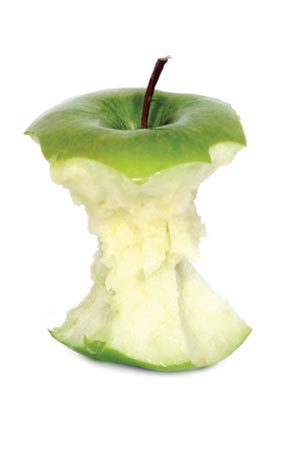
Apple/Pear Cores: Some people just go all out, and don't let a single bit of their precious fruit go to waste. Have you ever known someone who eats apple cores, or maybe the cores of pears? I can tell you that I don't mind eating the core of a pear, however apples tend to be a little past what I can handle. The seeds in apples are extremely bitter (which you've probably found out if you've accidentally eaten one) which is due to the fact that they're very mildly poisonous, containing a derivative of cyanide. Don't worry, you'd need to eat a TON of apple seeds to actually poison yourself, but it's just something to keep in mind. Feel free to eat the core of either fruit, just know that unlike banana peels and watermelon rinds, you're not consuming any sort of normally ignored health beneficiaries.
Mushroom Stems: For some reason, people like to throw away the stems of portobello and white button mushrooms. Why is that? The stems are just as tasty as the mushroom itself, and contain all the same health benefits, such as cardiovascular system support, anti inflammatory properties, antioxidants, and large portions of vitamins such as vitamin B2, B3, B5, and minerals like selenium, copper, and potassium. Seriously, eat these things, they're tasty and great for you!
Peach Pits: Just kidding...don't eat these...big choking hazard.
Avacado Pits:......Seriously? .........No.
So there you have it, a little look into the forbidden parts of food. Some things you may want to definitely try out, a few others you can keep avoiding, knowing you're not missing much. But don't worry, no matter what, as long as you're consuming the foods associated with these normally discarded portions, you're doing your body a whole bunch of good. Eat up, and as always...
GOOD LUCK!
References:
Thursday, February 16, 2012
Lifting For Two
Are you a gym loner? Are you one of those people who hits the gym solo, day in and day out, in your own little world, at your own intensity level, and with your own goals in mind? Well, thousands upon thousands of people are, and you know what? That's just fine. Some people work well alone, and most of the time I think I fall into this category just fine. For months on end I've been hitting the gym solo, and have gotten plenty of personal records in the process. Lots of people do the exact same thing with great success, so what's the problem? Well, the thing is, by working out alone, you may be falling into a hidden trap, and squandering your own potential.
What do I mean? Well, let me put it this way. It's much easier than you think to set both your goals and your intensity levels far too low, and lose out on quite a bit of possible muscle gains. In fact, you could get stuck in a rut without even realizing it. Sure, I've given you ways to prevent this, such as setting short term goals which you have to try your darndest to stick to, or getting your diet right so you have maximum energy and feel ready to hit the heavy stuff day in and day out. But honestly, the most effective motivation in a workout is sometimes just another person.
I can speak from personal experience here. Whenever I've had the pleasure of another person to lift alongside, I've felt better and more motivated than any other time. The reasons for this are quite simple, and I bet you all could figure them out. However, because that wouldn't make much of an article, I'll post them here regardless:
Assistance: Whether it's loading the weights, checking for good form, or just moving equipment around in general, you can get your next workout set up faster with someone else helping you. You can also make sure you're doing it right. Though a mirror works fine to check for squat depth, it'd sure be nice to have someone else there checking it for me as well. And if your back rounds during a heavy deadlift, they can yell at you to drop that sucker before you get hurt, before you actually GET hurt. That'd be nice, wouldn't it?
Distraction: When the weight gets heavy, and you're there alone, that's all you can think about. It's just you, under this stupidly heavy weight, and you need to squat it from top to bottom to top again. And god it's heavy, why's it so heavy? It wasn't this heavy yesterday, was it? Oh my god I can't do this. But I'm going to try anyway...so I here I go...and then BAM! You fail. You dump the weight, make some noise, and miss a chance at another PR. Sucks, doesn't it? There are two ways to alleviate this. Take some weight off (hah! like that'll happen), or get a friend to come and watch you. Performing for someone else can actually have a positive effect on lifting ability. Your friend creates a distinct distraction that can easily take your mind off the task at hand, and instead get you into the right mindset to make the lift. They can talk to you, root you on, tell you to push harder, and most likely you'll listen, and succeed. Plus, having a friend there makes even the longest workouts fly by. Just don't get chatting instead of lifting.
Competition: This used to be my driving force back in high school, with a guy named Cameron Stiles. He and I would go back and forth trying to push out more reps with more weight (in fact our motto was jokingly "more weight, more reps, less rest") than the other could do. Usually he won, considering he had about 10 lbs more muscle than I did, and was also built like a full-back (short arms, short legs, resembling an M1 Abrams Tank if you squinted.) Nevertheless, he pushed me to get stronger faster than I ever had before, and god was it fun trying to beat him. Next chance you get, bring a bud to the gym who's around your strength level, set up a few competitive lifts, and have at it. You'll not only get a great workout in, but you'll feel like a beast WHEN you beat him. And if competition doesn't get your mind in the right place to lift, I don't know what will.
Encouragement: I've sort of covered this one already, but on a hard rep sometimes someone yelling appropriate encouragement can really push you through. Keep in mind this needs to be the right tone of voice, intensity, volume, etc., so most likely not every one of your buddies will get you lifting that last rep as efficiently as they could. For me, again, it was Cameron. He had a way of yelling at me that just made me angry, energized, and extremely determined to get that last rep. Haven't found someone else yet who could do the same. But give it a shot, bring a friend and egg each other on, because a little encouragement can go a long way.
Safety: Now this one kind of seems like a no brainer, but I'll mention it anyway. Squats I'm not so concerned about, anyone who really knows what they're doing can dump a bar backward or forward, but on something like a bench press, seated military press, or anything else where you're suspending a bar over your body with no place to really throw it if it goes bad, it'd be nice to have someone there to pull the thing off you when you can't lift it anymore, right?
A Few More Reps: This one kind of goes with the safety topic, though not exactly. See, when you're benching alone, you know you need to rack it before you get to that one "grinding" rep, where you may or may not get stuck under the darn thing. If you have someone there spotting you, and they know what they're doing, you can ALWAYS go for broke, and go right until you can't lift another rep. Then, the best part is, your friend can help you push one more out by gently, lifting up on the bar and alleviating some of the weight on the concentric phase. Heck, you can do that same thing four or five times and really push your body over the edge so much that it HAS to grow to adapt. Go past your max, and you'll put on muscle, quick.
Creativity: If you put two brains together, usually you can come up with better programming and more effective exercises than you would normally on your own. You can discuss what you're feeling in your bodies throughout the workout, and determine what your next lift should be accordingly. You can even design routines and lifts on the spot, and confuse your muscles enough so that they'll be forced to grow big and strong. And trying new and crazy things can really make you feel impressively strong, and walk out of the gym that day feeling truly accomplished.
So there you have it, exactly why you should try to work out WITH someone else the next chance you get. You'll push harder, be more efficient, creative, and effectively worked. Plus, I can almost guarantee that it'll be a lot more fun (if you're working out with someone you actually like...). Give it a shot, I'm pretty sure you'll see what I mean. Progress comes quickly when someone else is there to help.
Get a buddy, hit the heavy weight, and as always, GOOD LUCK!
Tuesday, February 7, 2012
Food Worship #12: Mushrooms
First, a little background of the white button mushroom. Its formal scientific name is Agaricus bisporus, and according to Wikipedia it is also called by the names: common mushroom, button mushroom, white mushroom, table mushroom, champignon mushroom, crimini mushroom, Swiss brown mushroom, Roman brown mushroom, Italian brown,Italian mushroom, and cultivated mushroom. That's quite a few names to keep track of, if I don't say so myself. Amazingly, when these things are full grown, their known by a much more familiar name, the Portobello mushroom. Funny how things work, right? Nowadays, the white button mushroom is grown and cultivated all across the world. The process isn't too complicated, first a bed of manure and fertile soil is put down and raised to about 70 degrees Fahrenheit. The mushroom spawn are then laid over this growing bed, which is in a dark, sun-free location, and the temperature is then dropped to around 55 degrees Fahrenheit as the spawn take root. The spawn are then covered with about an inch of soil, and 3-4 weeks later they're ready for harvest and use in your recipes!
But why is this simple food so darn good for you (and tasty)? Well, let's explore the actual composition of these little mushrooms, and the nutritional benefits that lay within each one just waiting to spice up your diet and do your body some real good:
Immune System Support: White button mushrooms can help you stay healthy throughout the year with a couple of unique nutritional benefits they offer. Certain chemicals in these mushrooms actually interact with your white blood cells, and allow them to do their job more effectively. In simple terms, if your body needs more active white blood cells, the white button mushroom can help to activate a greater number of cells to assist your body. That's really an interesting trait of ANY food, and what's more the white button mushroom is actually BETTER at supporting your immune system than almost any other (more expensive or exotic) mushroom type. Cool!
Antioxidants: White button mushrooms are a food rich with all sorts of antioxidant benefits as well. Each mushroom is packed with antioxidant related nutrients like zinc, selenium, and manganese, and these little mushrooms are also excellent at helping your body to produce its own oxidative enzymes to help prevent cell damage from oxidation.
Heart Health: These mushrooms also are conducive to helping that heart of yours to beat stronger and more efficiently. They have incredible anti-inflammatory properties which cause your veins to remain less constricted, and the antioxidant benefits you receive from each mushroom can help to protect your blood cells, veins, and arteries from free radical damage. These little guys also have been shown to lower LDL cholesterol (the bad stuff) quite effectively, which is definitely a help for remaining healthy in later years.
Vitamins/Minerals: You knew it was coming, time to look at all the other little goodies that white button mushrooms come packaged with that will help your body to remain healthy and strong. This time, I'll list it in chart form, to hopefully let you see the nutritional profile of these mushrooms a little more clearly.
White Button Mushrooms have:
9% DV vitamin B1
40% DV vitamin B2
27% DV vitamin B3
21% DV vitamin B5
52% DV selenium
10% DV of both zinc and manganese
These mushrooms are VERY nutrient dense, and clearly can add a lot to any meal. Here are the nutritional facts for 1 CUP of white button mushrooms:
| Nutrition Facts | ||
|---|---|---|
| Calories 21 | (88 kJ) | |
| % Daily Value 1 | ||
| Total Fat | 0.3g | < 1% |
| Sat. Fat | < 0.1g | < 1% |
| Cholesterol | 0mg | 0% |
| Sodium | 5mg | < 1% |
| Total Carbs. | 3.2g | 1% |
| Dietary Fiber | 1g | 4% |
| Sugars | 1.6g | |
| Protein | 3g | |
| Calcium | 2.9mg | |
| Potassium | 305.3mg | |
As you can see, these mushrooms are low in carbs, high in fiber, and have almost no fat. I munch on them raw sometimes as a low calorie, filling, and delicious snack. I suggest you try some out; they're actually quite tasty. If you don't like them raw, saute them up (without using too much butter) and add them to almost any dinner without any trouble whatsoever. It's a great low calorie filler that tastes heavenly.
So there you have it, the white button mushroom. I strongly suggest you try a few of these in your next available meal, and I can almost guarantee you'll be glad you did. They're tasty, nutritious, and readily available at your nearest grocery store. So what are you waiting for? Go pick up some fungus!
Be creative, enjoy your buttons, and as always, GOOD LUCK!
References:
Subscribe to:
Posts (Atom)


.jpg)