Showing posts with label whole. Show all posts

Monday, April 9, 2012

Eating For Your Goals


I'm back again after a long weekend filled with homework, but I definitely wanted to make sure I addressed what I consider a very important topic regarding diet and exercise.  Now I may have touched on it once or twice (or about ten times...), but never have devoted an entire article to this simple little piece of wisdom.  And that special nugget of knowledge, my friends, is that even if you're training hard as heck to accomplish whatever goals you may have set in the gym, you're only concerning yourself with half of what you need.  That's right, if your diet doesn't compliment your goals, you may never reach your true potential under the bar, on the track, in the pool, or wherever else you want to make your mark on history.

Now sure, we all know to "eat healthy, whole foods."  But that's wayyyy too general to work sometimes.  I'm talking more specifically about eating a diet tailored EXACTLY to your sport or activity.  If you haven't done the research and adjusted your intake regarding both quantity, quality, and what exactly it comprises, then you aren't going to hit it perfectly day in and day out like you need to in order to become the best.  Let's delve into this a little further, and see exactly what I mean.

Before I go much farther, let me address one thing.  I mentioned eating was half of performing well.  Actually...it isn't.  You can eat crap, train as hard as physically possible, and still see results.  But will they be optimal results?  Will they come as quickly as physically possible?  Will you look and feel your best the most possible amount of days?  If you say yes, you're kidding yourself.  OF COURSE NOT.  Eating may not be everything, but it's a HUGE part of performing the way you want to perform.

Now each sport/activity/goal you have in mind has a specific diet type that works optimally for the desired results.  Here are a few examples of what you need to be eating based on what exactly you want to achieve:

Lose fat:  Clean foods, raw foods, whole foods, all in a caloric deficit will work very well.  To see optimal results, keep a lot of water in your diet, keep the sugar far away from your piehole, and make sure you're getting lean meats dense with protein, complex, slow digesting carbs full of fiber and whole wheat, and healthy fats like nuts and olive oil.  You MUST keep in a caloric deficit though, which will be a different value for everybody based on weight, age, metabolism, muscle density, and all sorts of other factors.  To lose large amounts of fat, ketogenic diets (very low carb) diets have been known to work well, and I have a whole article on those, so read up.

What doesn't work as well:  Junk foods, high in saturated fats, hydrogenated fats, and especially lots of sugar.  Sure, if you're in a caloric deficit at the end of the day, that's great, and you'll still lose weight, but I can almost guarantee it won't happen as quickly or efficiently as possible.  You're basically using up calories that instead could be replaced with lean meats to help maintain muscle mass and fiberous veggies that will keep you full.  If you eat like crap, you'll tend to look like...well...you know.  

Gain Mass:  Lots of food.  You need to be in a caloric excess at the end of the day, but try to keep an eye on the actual amount you go over your maintenece (the number of calories you require to maintain your weight).  Overshoot this number by too much, and you'll start putting on an excessive amount of fat.  And we all know the name of the game when gaining mass is trying to put on muscle with as little fat as possible.  To do this, like I'll always say, keep it clean, but calorie dense.  Red meats are great, as are scoops of peanut butter and sweet potatoes.  Gaining mass isn't about eating anything and everything in sight.  This is what's called a "dirty bulk," and almost always results in too much fat gain and very little actual muscle gain.  Train hard in the gym, do big, compound lifts, and don't skimp on the meals.

What doesn't work as well:  Obviously, eating under or at maintenance levels will make any gains in size impossible.  Yes, that's right, IMPOSSIBLE.  It goes against the laws of nature.  If you don't consume more energy than you use, your body won't have an excess to build things bigger and stronger.  So if you're trying to gain a six pack AND get bigger, you might as well forget about it.  Focus on the muscle, eat big and often, and worry about cutting up later.  Seriously, there isn't much more of a futile situation than trying to get big and eating too small.  Get it?


Gain Strength:  Here's the deal, if you're looking to gain strength, like gaining mass, you need food.  Sure, keeping it clean is always the goal.  Eat a boatload of protein, lots and lots of complex carbs, and as always, healthy fats like nuts and seeds.  Eat a LOT of them.  Your body needs every ounce of fuel to replenish itself for maximal loading as frequently as possible.  Here's the deal though.  Strength athletes, if truly specific to their sport, generally don't get all the power they need from healthy, clean foods.  Usually they'll throw in a few borderline foods, and many just go all out on the junk.  Sure, it's bad for you, but a burger, a piece of meat pizza, and a pile of fries really helps you push a LOT of extra weight up.  Believe me I know, some of my best squat sessions were after an accidental overload of food the night before.  All that caloric energy, while not optimal for lean looks and rippling abs, sure works great for strength.  Would I reccommend going for the junk?  HECK NO!  I believe there's always a clean alternative, and here it just lies in eating more food.  Drink milk, eat peanut butter, have a couple of sweet potatoes.  That'll give you the energy.  It may fill you up, but hey, your stomach could lose a bit of stretching. 

I will say this however.  If you're training for strength, you're not allowed to cry if you slip up and eat a burger and a few pieces of cake.  Remember, you don't train to be lean, you train to be strong.  If you go over caloric requirements, even by a lot, so what?  Use it to fuel your workout.  Eat as best you can.

What doesn't work as well:  Obviously, less food doesn't work.  Cutting carbs DOESN'T WORK.  Low calorie diets DON'T WORK.  Heck, I'll say in general that trying to put a cap on your calories DOESN'T WORK! If you want to be strong, eat when you're hungry, eat a LOT whenever you can, and make sure you're working hard enough to stay hungry frequently.  I will say that unlike mass gain, it IS possible to get stronger without excess calories, but it's definitely slow going for anyone other than a newbie.  High carb, high fat, high protein.  That's the name of the game for strength under the bar.  

Before you go thinking you can deadlift that, realize that those big plates are 100lbs a piece
Endurance:  Carbohydrates.  Need I say more?  If you're running miles upon miles a day, you need carbs, both simple and complex.  I'm not a runner, so I can't give you a specific diet that will make you as successful as possible.  But I will say that from the endurance athletes I've met, they're always shoveling in the pasta, fruit, and veggies.  Sure, they eat a lot of lean protein to help rebuild ripped up muscles (and pop a lot of joint supplements for those pounded ankles), but as far as I know the main focus is carbohydrates.  This goes for swimming, running, biking, hiking, or other sports/activities where you're active at medium-high intensity levels for extended periods of time.  Your body needs fuel, make sure it gets enough.  

What doesn't work as well:  Well honestly, I was going to say ketogenic diets.  However, I know that there are runners out there who follow ketogenic diets and are quite successful.  I believe these people have been on keto diets for quite some time though, and personally I don't believe it's the greatest idea to limit carb intake and expect to perform as well on extended runs, bike trips, etc.  Don't limit carbs, don't eat in a caloric deficit, and for obvious reasons DON'T DEHYDRATE YOURSELF.  Lots of water, LOTS AND LOTS!


Listen, once again, if you don't eat for your goals, you're probably not going to reach them.  I say probably because for some reason, certain people get lucky.  But those people are few and far between.  Not losing weight?  I'd look to your diet first.  Not improving on your lifts despite lifting heavy day in and day out?  You're probably not eating enough.  Trying to gain mass but the scale won't budge?  Heck...EAT MORE!  Can't seem to run a 5 minute mile?  Well, have a big plate of spaghetti the night before and see if you just can't break that barrier tomorrow.  It's simple stuff.  Sure, there can be lots wrong with a training program, but I'd really make sure your diet isn't off kilter first.  Have a good food base, and go from there.  After all, we are what we eat, and I'll take that saying a step further and say our accomplishments tend to reflect what we eat as well.

And then there's Chad Ochocinco who eats McDonalds every day and still seems to perform better than was thought to be physically possible.  *sigh*, it's people like him that take away credibility for the healthy stuff.  Oh well.  There's only one of him, and there's many more people like you and me....the normal people.  Just don't follow his example, OK?  Please?

He eats McDonalds EVERY DAY!?!  As Chad would say..."Child Please.."

Eat to be strong, to be fast, and to win.  Good Luck!


Wednesday, February 8, 2012

Flatout! Multigrain Flatbread *Review*


It's not often you come across a food that's a remarkable step forward in terms of health, convenience, price, and taste.  However, I have to share with you a recent find of mine that I came across in my local Walmart when buying food to stock up my dorm room.  I was looking for whole wheat bagels, and instead came across a brightly colored flat plastic package proclaiming "Flatout!"  Intrigued, I picked it up.  And after reading the front, back, fine print, nutritional information, AND ingredients, I immediately tossed the package in my cart and have been thoroughly enjoying its contents for about a week now.

So what did the package contain?  Well, Flatout makes healthy flatbread/tortillas/wraps, and I've always been a HUGE fan of making wraps containing all sorts of delicious meats and veggies.  They taste amazing, and Flatout flatbreads are NO exception.  I bought their multigrain variety, which not only contains Flax seed and Omega-3 fatty acids, but is made from 100% whole wheat bread.  WOW!  Now that's some serious health horsepower.  But upon reading into the nutritional information and macro-nutrients a little more, the story just gets even better.

What else do these flatbreads have going for them?  Hmmm...where do I begin?

These things are packed with fiber!  Every flatbread has 17 grams of complex carbohydrates, 8 entire grams of which is fiber!  8 WHOLE GRAMS!  That's a LOT of fiber, and is a fantastic addition to any diet.

Not only are you getting a very manageable dose of some of the healthiest carbs you can find, but you'll also get a great dose of protein!  Each flatbread has 9 grams of protein!  Yet again, I say WOW!  That is quite a bit of protein for just one little wrap.  So far I'm loving it.

Also, Flatout flatbreads have only 1 g of sugar per serving, and 2.5 g of unsaturated fat (no saturated fat!  NICE!).  The flax seed adds a whole bunch of Omega-3 as well, which just about everyone needs in their diet. Put some tuna in one of these wraps and you'll be getting enough Omega-3 EFAs to keep your heart happy and healthy for quite some time.

But Flatout flatbreads don't only impress me with what they contain, they also cause great excitement for what they DON'T have.  What am I talking about?  Well in many 100% whole wheat products these days, you'll find that hidden killer, high fructose corn syrup.  That stuff is the devil, and will add fat to your bones quicker than you can get to the nearest dumbbell.  Flatout flatbreads though have none of this, as well as no other crazy, unpronounceable ingredients.  Only the good stuff goes into these breads, and that's just plain awesome.

And did I mention they're only 100 calories EACH!?!

Here are the nutritional facts for Flatout flatbreads:


 Needless to say, I love these things.  They're easy to make into all sorts of amazing culinary creations.  Some days, for a quick and healthy in-dorm breakfast, I make a simple wrap that contains:

1 Flatout! Multigrain flatbread wrap (100 calories)
1 cup of Southwestern style egg beaters (aproximately 110 calories)
3 White button mushrooms (sliced with mandolin) (15-20 calories)
Whatever other veggies I feel like throwing in (would love some diced onions or peppers!)

I basically slice the veggies into the egg whites, stir it up, add some cayenne pepper, and cook it for about two minutes.  I then scoop out the mix onto a Flatout! flatbread wrap, twirl it up nice and tight, and I've got a high protein, low carb breakfast for low calorie days.  Not to mention it's DELICIOUS!

But that recipe is ridiculously simple compared to some of the stuff they have on their site.  Check this out:

Photo of Arugula Mushroom Flatout Thin Crust Pizza


Arugula Mushroom Flatout Thin Crust Pizza
Posted in Grillin' Pizza
1 Flatout® Light Flatbread
1/2 cup fresh, sliced and steamed mushrooms – shiitake, button or portabella
2 Tbs onion, sliced
6 grape tomatoes
1 Tbs olive oil
1 1/2 tsp fat free balsamic vinegar
Salt and freshly ground pepper to taste
1/2 cup baby arugula
1 Tbs freshly grated Parmesan cheese

Preheat outdoor grill. While grill heats, toss mushrooms, onions and grape tomatoes with olive oil; season to taste with salt and freshly ground pepper. Saute 6 to 8 minutes. Lightly oil both sides of Flatout. Cook Flatout on closed grill for 2 minutes. Remove from grill and top with arugula, sautéed vegetables, Parmesan cheese and drizzle with balsamic vinegar. Cut into slices and enjoy!
Alternate Cooking Options: Cook lightly oiled Flatout in 350°F oven directly on grate for 7 minutes. Remove, top with arugula, sautéed vegetables, Parmesan cheese and drizzle with balsamic vinegar. Cut into slices and enjoy!


Does that look good or what?  Check out some other fantastic recipes right on their site:
http://www.flatoutbread.com/category/recipes/

All in all, these wraps are fantastic, a real slam dunk in the diet world.  They're made with quality ingredients, are extremely healthy, and taste absolutely fabulous.  They're moist, thick, and flavorful, and boy do they go great with almost anything.  My rating?  An easy 10/10.  PICK SOME UP TODAY!!!!

Oh, and tell them the Food Guru sent you.  Good Luck!


Friday, December 2, 2011

To Shake or not to Shake?


Whether you're new to the fitness scene, or a seasoned veteran in the gym, chances are you drink a protein shake at some point during your day (usually around your workout, though I've known some who decide to chug one any old time.)  If you've got a good brand of protein, I bet you love the shake, and I bet it feels great to give your body what it needs right after a tough workout.  You may have even seen some pretty good gains off of the stuff, both in the strength and looks department.  There's no doubt protein shakes are great fitness tools, and it's easy to see why so many are sold on them for daily usage.

But why stop at one?  I've known many people who decide they'd like to get bigger and stronger, and decide in order to do so they'll just stick another protein shake in their diet at some random point in their day.  And so now, they chug one protein shake after their workout, and one whenever they feel like it.  If they feel like they'd REALLYYY like some more muscle, they may even stick a third in there somewhere.  Heck, I've known some people to drink as many as 5-6 shakes a day, all in hopes to gain lean muscle mass quickly.  I don't care who you are, 5-6 shakes a day is a LOT of whey protein.  But still, what's the big deal, it'll work...right?

Eh...not so much.  Listen for a second.

What many people in the fitness world fail to realize is that whole food (actual meals, chicken, corn, beans, rice...etc...) still drastically outranks any protein shake in the nutritional department.  To start removing all those fantastic nutrients from your diet in exchange for a shake is a very bad idea, because you will start to leave yourself starved of most of the good stuff.  Your body wants whole food, and trust me it'll go a lot farther than a liquefied shake.  

Shakes just don't have the same kind of nutritional value as whole food.  Sure they've got a ton of protein, but they're lacking many essential nutrients to regular bodily function.  And you know what?  It may be confusing to hear, but in the muscle building department, protein ISN'T EVERYTHING.  You can overload your body with as much protein as you want, and your body will still only use a fraction of it.  Most of it will go right in and right out of your system, doing nothing but wasting your time and money.  Your body needs a very specific environment in order to build a lot of muscle as quickly as possible (which isn't very quick no matter what, mind you), and guess what's the easiest way to ensure you're providing this ideal bodily atmosphere?  EAT FOOD.  You need carbs, you need fat, you need natural, non-synthesized nutrients in order to help your body use all that extra protein you're giving it to its fullest potential.  I'll repeat again, if you're just drinking a ton of protein shakes, more than likely they're going in and washing right out.  


Food also has a thermic effect on the body.  This means that it requires energy to digest, where as shakes are predigested and absorb much more quickly into your system.  After a workout, this is great, because you get nutrients as fast as possible, but any other time of the day this isn't needed and is NOT an ideal scenario.  You need to work your digestive tract, and you'll burn more calories doing so anyway.  

There's also speculation about what excess protein supplementation can do to your kidneys.  Believe it or not your kidneys have to work pretty hard to filter all that junk out of the water it's dissolved in, and the more protein you take in, the more work they have to end up doing.  Will it cause kidney problems?  Probably not, especially if you're drinking enough water.  In fact I truly doubt you'll ever see any negative effects of protein shakes as long as you're not going overboard.  But ya know what?  It's something to think about, and in order to keep your kidneys healthy, and be safe rather than sorry, I'd suggest limiting your protein shake intake and increasing your water intake.  

And finally, DON'T BE AFRAID TO EAT.  It all comes down to the most effective meal (nutritionally) for the calories you're consuming.  Guess what, if you're trying to get a few more quality calories in, protein shakes are NOT the answer.  Sure they'll give you a ton of protein, but again, that protein will do diddly squat without other nutrients to support it.  Enjoy real food.  Try new recipes every day.  Give your body what it really needs.  Protein supplements are just that...SUPPLEMENTS...meant to be taken only when it is more convenient to do so (like right after a workout at the gym, where I doubt you have an entire kitchen setup to make a nice healthy meal right after that last set.)  Would I replace my post-workout shake with a real meal if I could?  You bet your bottom I would!  It'd probably do me a lot more good than some shake, no matter how delicious that shake is.  In fact, let me put this is bold:

TO SEE MUSCLE GAINS, YOU DO NOT NEED PROTEIN SHAKES.  YOU CAN GET BETTER GAINS OFF OF REAL FOOD THAN YOU COULD WITH ANY SHAKE ON THE MARKET.  


Here's my recommendation:  Drink 1-2 shakes a day, max.  Drink one after your workout, as this is the time your body needs it most.  If you leave your body starved after working it to the breaking point, you're completely screwing yourself over for any sort of gain.  The second shake you can drink when you want, but I'd suggest it in the morning, when your body is crying for food after not eating all night.  I have whey protein powder in my oatmeal, but hey, close enough.  Those two times are generally the most effective for protein absorption   If you can have a real meal instead though, do it.  Just make sure you're getting all your required nutrients.

Shakes are meant for convenience.  They are not an excuse to be lazy nutritionally.  Cook your food, plan your meals, design them to fit your caloric and macro nutrient needs.  Put some work into it!  You'll see better results in the long run, I guarantee.  


Keep eating, love those whole foods, and as always, good luck!

Thursday, November 3, 2011

All Sorts of Milk


Let's talk about milk.  I know it was my favorite drink as a kid, and it's an extremely important liquid in anyone's diet.  Milk is rich with nutrients, protein, and all sorts of other goodies that will keep you healthy and happy for years to come.  But when you usually buy milk, you may notice how many different choices there are.  Some doesn't even come from the good ol' moo-cows either, which to some people doesn't make much sense.  Are these "alternative" milks better for you?  Or are they lacking certain ingredients that may cause them to leave your body starved of milk's otherwise great health benefits?  Let's figure it out.

1%, 2%, and Whole Milk:  These varieties of cow's milk have been around FOREVER.  And there's good reason, because they're some of the most beneficial meal accompaniments you could ever have.  Whole milk basically means the natural fats remain in the liquid, so it tastes much thicker and creamier.  There are 150 calories in whole milk, 120 in 2% milk, and 100 calories in 1%.  All three varieties have 8 grams of protein and quite a few nutrients.  As we all know, cow's milk is filled with calcium, Vitamin A, and Vitamin D.  It's also rich with Riboflavin and Phosphorus, and while not quite as significant as the amount of these vitamins, milk provides a good dose of almost every other vitamin across the board.  Milk really is a kid's best friend, and that's why so many doctors suggest feeding milk to growing children.  It will support muscle growth, bone strength, and load them up with the nutrients they need to develop.

But what about the fat?  There's a little bit of a debate about this one.  A lot of the fat in Whole milk is healthy fat, but there's plenty of saturated fat as well.  Now, saturated fat isn't inherently bad, but you want to limit your intake of it, therefore I don't suggest drinking a LOT of whole milk every day (I'd limit it to one 8oz glass.)  The good thing about this fat though is that your body can more readily absorb the nutrients in milk with all that fat present, because a lot of the vitamins and other nutrients are FAT SOLUBLE.  You'll absorb a lot more Vitamin A and D from whole milk than its fat diluted counterparts.  


Skim Milk:  This milk is my personal favorite, and it's what I drank every lunch and dinner growing up.  It's basically cow's milk with all the fat skimmed off.  It comes in around 80 calories a cup, and still has 8 grams of protein.  While you may be sacrificing the good fats, you're also eliminating the saturated fats, which in my personal opinion is a good trade off.  I personally drink milk for the protein, but those looking to pack on a little muscle with a few more calories should probably look into a higher fat variety like those discussed previously.

Fat free milk actually may contain slightly more nutrients than whole milk, just because the fat takes up so much space in the liquid itself.  When it's gone, there's more room for the good stuff.  Like I said before, the absorption may not be quite as prevalent as with whole milk, but because skim milk still has lactose in it, Calcium is still readily absorbed.  And it's been suggested that a good amount of calcium in your diet may actually cause your fat burning metabolism to increase.  That's a great incentive to get a little more milk in your diet today!


Soy Milk:  This was the first alternative milk I'd ever learned about.  It was always an interesting concept to me, milk that doesn't come from a cow?  Who would've thought.  But this milk has always been a great alternative to those who are lactose intolerant (they can't digest the sugars in dairy milk.)  How is Soy Milk made?  Well basically, Soy beans are pureed very thoroughly, then the solids (called Okara) are strained out.  The "milk" is then boiled for about ten minutes, and voila!  Soy milk.  

Soy milk has around 8 grams of protein, and a LOT of fiber compared to dairy milk.  It's also rich in Isoflavones, which are thought to help prevent cancer.  This sounds all fine and dandy, but as healthy as these Isoflavones are, they're one reason why I personally don't drink soy milk.  Isoflavones are very close in chemical composition to the hormone estrogen, which basically fights the male body's natural testosterone levels.  While this is by no means serious if soy milk is consumed in average quantities, it's still a factor that may cause a decrease in muscle growth, or actual muscle depletion.  As a lifter, this is NOT something I need, and if any of you are looking to build some muscle I don't suggest soy milk as a dairy alternative.  

Soy milk does have fat, a little more than 2% dairy milk actually, however without the bad cholesterol.  The fat in Soy milk is unsaturated, and therefore heart healthy.  All in all soy milk is a good alternative milk for those with lactose intolerance, though I do believe there are better choices.  


Rice Milk: I hadn't ever heard of rice milk until one of my workout partners from high school was talked into going on a week long "cleanse."  He wasn't allowed to consume gluten, and the cleanse said that rice milk was a great alternative to gluten rich dairy milk.  I went over to his house that weekend, and he let me try a little.  It wasn't bad, it had a real unique taste that I enjoyed.  Rice milk is made from boiled brown rice that's pureed, then strained of the remaining solids.  It tends to be pretty translucent, but also naturally sweet from the rice flavor.  It has much less protein than dairy milk and soy milk, at around only 1g per cup, but it also has more carbohydrates than dairy, making it a great energy source.

Rice Milk is often fortified with Vitamins found in dairy milk, such as vitamins A and D.  It's also naturally VERY low fat at only around 2g of unsaturated fat per serving.  Calories in a cup?  Around 120, so it's about the same as drinking 2% dairy milk.  It is vegan safe, and lactose intolerant safe, and therefore makes a great alternative milk to those who cannot drink dairy.  What's great about rice milk is that it also can be an alternative milk to those who are allergic to nuts.  Soy and Almond Milk are both not safe in this regard, which puts rice milk a step ahead.  If you're looking for a new taste, or a different alternative milk, I suggest giving rice milk a try.


Almond Milk:  This happens to be my favorite alternative milk out there.  It's got a naturally "nutty" flavor and is extremely low calorie if you get the unsweetened kind.  Unsweetened almond milk is about 40 calories a cup, sweetened is 60 calories per cup, and vanilla sweetened is around 90 calories a cup.  Almond milk is extremely rich in healthy, unsaturated fats and is probably one of the most heart healthy liquids you could drink.  It still doesn't have too much protein, at only a gram per serving, so I don't usually drink it as a muscle building tool.  I will however mix it with protein powder if I'm looking for a nice slow muscle feed, because the natural fats in almond milk will help to slow the absorbtion of otherwise fast absorbing whey protein.  It also adds a nice creamy flavor.  

Almond milk is loaded with the same vitamins as dairy milk including:

  • Vitamin A
  • Vitamin E
  • Vitamin D
  • B Vitamins
  • Calcium
  • Phosphorus
  • Magnesium
  • Manganese
  • Potassium
The unsaturated fats in almond milk will also help these vitamins to readily absorb into your body for easy usage.  If you're looking to cut back on carbs, almond milk is a great choice, containing only 8 grams of carbohydrates per serving as opposed to 25 grams in rice milk.  It also has a little less sugar than rice milk, if the unsweetened kind is purchased.  All in all Almond milk is another great alternative to dairy milk, particularly because of all the nutrients it offers at such a low calorie density.  


So there you go....MILK, both traditional and non-traditional.  My opinion?  Try a few alternative milks, and switch it up every now and then.  Don't be afraid to try each and every one, they all taste fine, and each has their own unique set of nutritional benefits.  Fellow gym rats?  I suggest sticking with dairy.  Looking to drop a few pounds?  Try almond milk.  Want something sweet and unique?  Try rice or soy.  Every one has their place, see if you can give each one a try.

Keep chugging, wipe off that mustache, and as always, good luck!

Sunday, October 16, 2011

Breakfast: What You Should Have, And Why

Breakfast is the most important meal of the day.  There is no denying it.  This post will explain what you should have when you finally decide to crawl out of bed, why you should have it, and how it'll help you.


Why?  Because your body has been starving for 8 hours up until breakfast.  It's in a catabolic state (muscle fibers are deteriorating) right until it gets that next little bit of food.  The longer your body is in this state, the more essential muscle fiber you will lose, and the more your metabolism will decrease.  An early breakfast can help reverse this state quickly and kick your metabolism into high gear.

Breakfast will also be the meal your body depends on most throughout the day for energy.  So the pressure's on to make this meal your best (if you're going to choose just one).  But what can you eat that will ensure your body a good start to the day, and in turn produce a great feeling that'll keep you smiling and awake as the hours roll by?

A good place to start is with a good helping of natural, complex carbohydrates.  These will feed your body all day, and give you lasting energy, not to mention your muscles will get constant fuel.  For your carbs, you have lots of options.

You could have:

-Two slices of whole wheat toast

-A whole wheat bagel

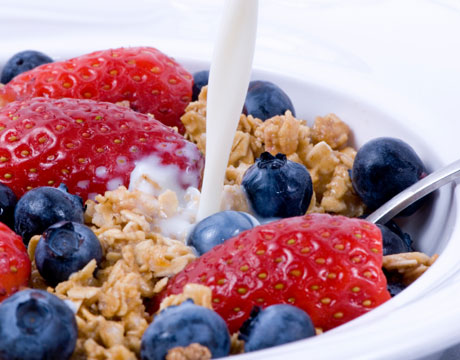
-Whole grain cereal (be careful on this one, a lot of cereals are absolutely LOADED with sugar, read the nutritional label and attempt to find a cereal high in dietary fiber and relatively low in sugar.  Cereal advertising oats, bran and whole wheat is a good place to start.  I would recommend some of Kashi's cereal).

-Whole wheat English muffin

-My personal favorite, and still probably the top contender for the all around BEST breakfast carb:
OATMEAL (and I mean good old rolled oats boiled up in the microwave, not that instant oatmeal.  That stuff is crap, I guarantee you.  Loaded with sugar and artificial flavoring.)

  Oatmeal is piled with complex carbs, or in other words, long lasting energy.  It also has a good amount of protein, and a large amount of dietary fiber.  It's some of the best fuel you could ever put in your body, as far as I'm concerned.  Give it a try, I bet you'll like it as much as I do in no time.

  But just a carbohydrate would be a pretty boring breakfast, eh?  So lets get some protein in there.  And where else but eggs?  Scrambled, fried, made into an omelette, they're all fine choices.  In fact you can go one step further and use cartons of egg whites.  This will take out any bad cholesterol from the yoke, and still be absolutely delicious with a little pepper and cayenne powder.
  You can also get protein from a dairy source, such as milk, or yogurt.  I would suggest skim milk, and greek yogurt, however you can choose what you prefer.  Just make sure to look at the nutrtional label and know what you're getting BEFORE you buy it.  Those sugar loaded yogurts will do you no good in the long run.

  One of my favorite breakfast compliments is a tablespoon or two of either natural peanut butter, or natural almond butter.  Either one is positively delicious on a microwaved bagel, and will give your body the good fats and protein it needs to function.  Give them a try.  For natural peanut butter I would suggest smucker's Natural creamy or chunky.  The only ingredient on the ingredient list is "peanuts".  You can't get much more natural than that.  Just stir the oil back in before usage, and flip the jar over every couple days while it's stored so the oil can float back up into the butter.

  And we can't forget about fruit.  The simple carbs that will get you going for the day.  This is completely your choice here, because nearly any fruit will do the job.  I prefer a banana or apple, but when I'm home from college I usually grab a peach, a plum, a kiwi, or even a mango.  Fruits are packed with nutrients that you need for the day.  You may substitute the fruit with a glass of natural 100% juice, but stay away from concentrates with lots of dye and artificial flavoring.  Just look on the ingredients list.  If you see High Fructose corn syrup, artificial flavor concentrate, and around 6 different dye colors, do yourself a favor and steer clear.

  So this is all fine and dandy, but as always you'll have to make some choices.  A lot of people may be wondering, how many calories should I be eating at breakfast?  While that's an impossible question to generalize, I will say this:  Breakfast should be the big meal of the day, as it will be your main energy source.  As a weightlifter I aim for 700 calories.  That may be a little bit over what you might want, but maybe not by much.  A good range to shoot for is around 400-500 calories.  And if you're still hungry, have another plum.  Your body needs this energy.

  And here's my final word.  Do not, I repeat DO NOT skip breakfast.  You may think it will help you lose weight.  It will do the EXACT OPPOSITE.  It will slow your metabolism down, make you extremely hungry later in the day, send your body into a starvation mode, and in general will make you feel like absolute crap.  Eat a healthy breakfast and I guarantee you'll feel better, look better, perform better, and even make a good first step toward losing those unwanted pounds, or gaining that much desired muscle.

Wake up and eat, my friends.