Wednesday, March 21, 2012

The Ultimate Tilapia Sandwich

A foodguru802 original recipe!  This sandwich is extremely healthy in almost every way, and it will not only taste remarkably delicious, but will help support lean muscle mass, as well as fit into your daily caloric intake quite effortlessly.  You can also make it as spicy as you'd like (as I show you)  Check out the video!


Remember, this sandwich has over 40 grams of protein, and less than 320 calories!  It also has great complex carbohydrates that will keep you energized all day.

I mean seriously, what else could you ask for?

Saturday, March 17, 2012

Biggest Bloat Foods


You work hard to look good, we all know that.  You're in the gym 5 days a week, you try to watch what you eat, and so far you've been having a lot of success on your fitness journey.  And like everyone else, you're human, and every now and then you decide to skip on the diet and consume a food you love.  Why is it that every time you do so, you wake up the next morning, look in the mirror, and look like you've gained a solid 5 pounds of fat?  I'll let you in on a little secret.  You probably haven't gained an ounce of actual fat, it's just that particular food you ate playing tricks on you.  So don't despair, just know the facts.

It's called bloating, and it's not a fun sight.  No, it's not dangerous, but it can really cause someone to become very falsely upset about their weight or appearance.  It happens when your body suddenly decides to retain water, or produce internal gas based on a food you may have consumed.  Certain foods (and their respective ingredients) can produce some pretty impressive bloats, so it's always good to know what caused this rapid degradation of appearance.  Let's go over the list of some of the types of food that will cause you to blow up like a balloon, guaranteed:

Food High In Sodium:  This one's the most common of all bloating situations; you decided to splurge, had a bit of a really salty piece of steak, or a few too many potato chips, or decided to go all out on salting that corn cob last night.  Excess sodium will cause your body to retain water in all sorts of places, because water is attracted to sodium.  It's not uncommon to put on a pound or two of water weight after an extremely salty meal, even if it did happen to be low calorie.  If you don't want to blow up like a beluga whale, try to skip the salt, and watch the sodium content on nutrition labels.  If you do accidentally go a little salt crazy, don't fret, just drink a lot of water and your system will eventually cycle all that excess water weight right back out.


High Carbohydrate Foods:  Your body uses carbohydrates as a very efficient energy source by storing carbs as an accessible fuel called glycogen in your liver and muscles.  When 1 gram of glycogen is stored as energy, about 3 grams of water is stored with it.  This means that if you've been quite glycogen depleted (working very hard in the gym, or have been on a low carb diet), and you replenish your glycogen stores by consuming a good amount of carbohydrates, you can put on a lot of water weight quite quickly, and tend to look pretty bloated, or at least "bigger" for a while.  Usually this isn't as bad as sodium bloating, and most muscle heads actually want this "inflated" look as it promotes a healthier, fuller, stronger looking physique.  Don't be surprised though if the scale bumps more than it should after that big plate of pasta.


Raw Vegetables:  Now don't start worrying, vegetables are still probably the healthiest food you can consume throughout your day.  The thing is though, raw veggies have huge amounts of fiber, and can absorb quite a bit of water in your stomach.  That means they take up a lot of space, and can cause you to look like a Macy's day parade float.  Don't worry, this will pass.  Also something to be a little wary of, most fiberous veggies produce a lot of intestinal gas, which, as well as being uncomfortable and...er...embarrassing, can inflate your lower stomach to the point where those tight jeans may not fit anymore.  Seriously though, it's a small price to pay for the health benefits in those veggies.


Artificial Sweeteners:  I love artificial sweeteners, and I use them on a daily basis.  They allow people to stay on a stricter diet more efficiently because they allow someone to have a bit of a sweet tooth without any of the huge sugar consumption.  They can, however, cause bloating, because your body can't absorb and digest them.  They act like fiber and cause intestinal gas, which, you guessed it, pumps you up to snowman-like sizes.  Again though, don't worry too much about it, just know what caused it.


Desserts:  There's a whole host of reason that those big, sweet, sugary desserts can cause bloating.  They're loaded with all sorts of carbs and sweeteners that both force your body to retain water and cause gas.  Also, desserts that contain dairy can be incredibly bloating to those that are lactose intolerant (as will any dairy product.)  Let me just say this: you're guaranteed to look like a beach ball after that heaping bowl of ice cream and apple crisp.


Carbonated Drinks:  This one's a no brainer.  Carbonated drinks contain little bubbles of carbon dioxide, which when consumed escape into your stomach and blow it up like a balloon.  This can cause a lot of discomfort.  Not to mention, most carbonated drinks are loaded with sugars and other artificial sweeteners, two other super bloat-promoting substances.


Bloating is annoying, that's for sure.  Is it dangerous though?  Not usually.  It also shouldn't be a reason to get depressed about your appearance, because bloating is a temporary state.  If you bloat up, just hop back on your diet as soon as possible, keep hitting the gym, drink lots of water, and your body will clear itself out eventually (usually sooner rather than later).  And now that you know the top culprits that cause the biggest bloats, you'll be able to figure out what happened next time you look like the Michelin Man in the mirror.

Eat clean, don't stress, and as always, GOOD LUCK!

Friday, March 16, 2012

The Discarded Portions, And What You're Missing


With certain foods, it's pretty commonplace to have a little scrap left behind.  Think of that yummy corn cob, or perfectly ripe banana, or absolutely delicious watermelon.  After a few pieces of each, your plate is littered with  cobs, rinds, and peels.  We don't think much of it, and usually toss our apple cores into the woods just like anyone else.  But what exactly are you throwing away?  Did you know that in certain cases, these "inedible" portions of food actually contain many nutrients that could do your body some serious good?  In fact, some may contain tons MORE health benefits than is easily fathomed.  And you know what?  Some don't taste so bad, either.

Watermelon Rinds:  This one you might have tried before, and you'd be happy to know that your instincts were correct in trying to munch away on this green nutrient goldmine.  In fact, the watermelon rind is actually healthier than the watermelon flesh, and though while it may not taste as good, consuming watermelon rind can give you a heaping load of beta carotene, vitamin A, citrullene (an important amino acid), lypocene, and vitamin C.  Now don't confuse the rind with the dark green outer skin, the rind we're talking about is the lighter green layer between the skin and the pink flesh.  The outer skin is a little harder to stomach (though I've definitely done it on several occassions.)  Next time you have a watermelon, feel free to keep chomping for just a few more bites, just to make sure you get a little of that very healthful rind.


Banana Peels:  You know, it's really only us humans who believe we're too good for a peel.  Many primates eat the entire banana, and by doing so gain a lot more of the fruit's total health benefits.  That's right, the peel, though slightly ropey and initially unappetizing, contains all sorts of goodies that your body will absolutely love.  They're rich with fiber, both soluble and insoluble, much moreso than the fruit itself.  This fiber can assist in raising good cholesterol levels and promoting healthy digestion.  Banana peels also have a significant amount of lutein, an important antioxidant.  Banana peels also contain a very large amount of potassium, a very crucial mineral which when balanced with proper sodium intake allows the management of bodily hydration.  To make banana peels a little more appetizing, wait until the fruit is very ripe, and the peel should be both thinner and slightly sweeter.  You can also boil or cook the peel, and many Asian cultures cook bananas IN their peel, and eat them as one total meal.  Cool, right?


Corn Cob:  OK, now seriously, who eats the cob of the corn?  Actually my loyal readers, I've done so on several occassions.  If the corn is boiled well enough, the cob is most definitely soft enough to consume, and doesn't taste half bad, in my opinion at least.  As far as health benefits go, I can't seem to find many on the internet, which means I must be a little bit strange to consume the cob.  However it's common knowledge that corn cobs can be ground up and mixed into cattle feed to increase fiber, so it's safe to say that the cob is extremely rich in fiber.  I can definitely agree with this, as they fill you up EXTREMELY quickly (one of fiber's most useful attributes, besides healthy digestion).  If you want to try a bite, I suggest you try eating the small end of the cob first, as it's likely to be the softest and most easily consumed. 


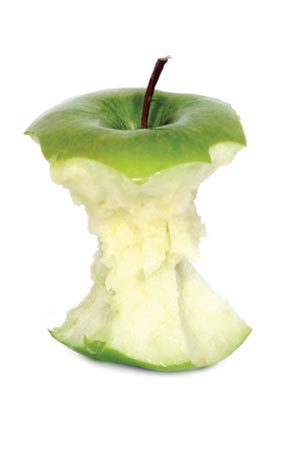
Apple/Pear Cores:  Some people just go all out, and don't let a single bit of their precious fruit go to waste.  Have you ever known someone who eats apple cores, or maybe the cores of pears?  I can tell you that I don't mind eating the core of a pear, however apples tend to be a little past what I can handle.  The seeds in apples are extremely bitter (which you've probably found out if you've accidentally eaten one) which is due to the fact that they're very mildly poisonous, containing a derivative of cyanide.  Don't worry, you'd need to eat a TON of apple seeds to actually poison yourself, but it's just something to keep in mind.  Feel free to eat the core of either fruit, just know that unlike banana peels and watermelon rinds, you're not consuming any sort of normally ignored health beneficiaries.  


Mushroom Stems:  For some reason, people like to throw away the stems of portobello and white button mushrooms.  Why is that?  The stems are just as tasty as the mushroom itself, and contain all the same health benefits, such as cardiovascular system support, anti inflammatory properties, antioxidants, and large portions of vitamins such as vitamin B2, B3, B5, and minerals like selenium, copper, and potassium.  Seriously, eat these things, they're tasty and great for you!


Peach Pits:  Just kidding...don't eat these...big choking hazard.

Avacado Pits:......Seriously? .........No.

So there you have it, a little look into the forbidden parts of food.  Some things you may want to definitely try out, a few others you can keep avoiding, knowing you're not missing much.  But don't worry, no matter what, as long as you're consuming the foods associated with these normally discarded portions, you're doing your body a whole bunch of good.  Eat up, and as always...

GOOD LUCK!

References:

Wednesday, March 14, 2012

The War Against Catabolism

Here's something fun to try:  Go up to the biggest, most shredded, most muscular dude you know, and say nothing to him but "catabolic."  Then proceed to watch him run and hide in the corner, frantically trying to mix up a protein shake and down it in as little time as possible.  There, see?  No need to be afraid of bigger guys anymore.


OK, so maybe I'm exaggerating a bit, but to any sort of fitness pro, catabolic can be a scary word.  In its simplest form, catabolism means nothing but the breakdown of molecules into simpler forms, and releasing energy in the process.  This happens all the time in your body, and actually is what digestion is defined as.  During exercise, your body is in a state of catabolism, breaking down nutrients and releasing energy to fuel those hard working muscles.  But once all those glucose/glycogen energy stores are depleted, your body has no choice but to start breaking down muscle in an attempt to find more energy to use.  When your muscles break down, you start to feel a burn, usually caused by the combination of lactate buildup and tears in your muscle fibers.  This isn't a completely bad thing, because after your workout, your body makes it a priority to build back your muscle bigger and stronger than it was previously in hopes to avoid future states of the same "injury."   And if you have a post workout meal (WHICH YOU SHOULD), you can very rapidly throw your body from a catabolic, muscle eating state, to an anabolic, or growth state.

So catabolism isn't always a bad thing, however there are definitely times when you DON'T want to be catabolic.  Remember, basically any time your body is catabolic, you can't get bigger and stronger.  It simply won't happen, as your body is eating muscle instead of building it.  Therefore, it's pretty safe to say that other than intense exercise, you want your body in a purely anabolic state of muscle growth and repair.  Remember, your muscles don't grow while working out, they grow while resting.


So how do you avoid a catabolic state throughout your day?  Well, the good news for you is that it's pretty hard to enter a catabolic state if you're getting proper nutrition and calorie intake.  But remember the two main causes of catabolism:  Working out intensely, and fasting.  If you're fasting for hours on end, you might be depriving your body of the anabolic state it needs to rebuild muscle after a workout.  In order to assure that you don't enter a catabolic state throughout your day, try these tips:

Eat Frequently And Consistently:  Most fitness enthusiasts will tell you to have 5-6 medium sized meals a day, and this is very good advice if you're looking to promote an anabolic state.  If you're always eating, your body is almost never waiting for food, and will always have new nutrients coming in to rebuild what you've broken down.  However, do you HAVE to eat 5-6 meals a day to keep anabolic?  Well, people used to think that was really the only way to do it, but for the most part, it's been disproven.  So no, 3 meals a day should suffice, and if you're into intermediate fasting, that has been shown to keep people in anabolic states as well.  I guess I'm still on the old train though, and I'd say if you can, eat more frequently than not.  Better safe than sorry, right?

Eat After Your Workout:  I've already mentioned this one above, but post workout nutrition is EXTREMELY important to prevent continued catabolism after an intense workout.  Your body is already pretty beaten up after you've racked the weights or stopped the treadmill, and is already in the process of breaking down your muscle to very weakened levels.  It's quite advisable to get out of this catabolic state ASAP, in order to see the best gains.  So have a good amount of protein, and a few carbohydrates (about a quarter of your daily intake) to get your body building instead of breaking.  A protein shake and a banana or some oats are a couple of great choices.

Eat Before Bed:  Tell me something; when's the longest period of time you will have to go without food?  Night time of course!  Or more accurately, when you're sleeping, whenever that may be for you.  Unfortunately, that's also the time your body is doing the most muscle repair, and therefore it's crucial to have nutrients available for your body to use when it's repairing muscle.  There's this stupid thought that a couple hours before bed is a time when you should avoid food at all costs because your body won't get a chance to use the nutrients it provides before you go to sleep, and therefore it'll just get stored as fat.  That's ridiculous.  If you're eating within your calorie range, you won't store fat no matter when you eat.  And believe me, your body will thank you for the food you give it before you hit the hay.  I can promise you'll see big muscle gains too, because this is the largest time of muscle growth in the day.

So what should you eat before bed?  The general rule is to have a food rich in healthy fats, which will help to slow digestion, and a slower acting protein (casein.)  Probably one of the most famous pre-bedtime meals is some natural peanut butter and some cottage cheese.  This will provide you with a whole bunch of healthy unsaturated fats, as well as a ton of casein protein.  The amount of each you consume will depend entirely on your goals and your calorie requirements, so study up!


Catabolic states are a natural occurrence, and shouldn't be considered bad, but if you're looking to get as fit and lean as you can be, you want to make sure your body can build up muscle in the most efficient way possible.  I've given you a few tips, so now you know what to do and what to watch out for.  If you have any questions, just post a comment, I'm guaranteed to respond.

GOOD LUCK!

Sources:
http://www.fitday.com/fitness-articles/fitness/body-building/what-is-a-catabolic-state.html 
http://www.bodybuilding.com/fun/david7.htm