Showing posts with label Important. Show all posts

Saturday, December 10, 2011

Train Those Triceps


I bet you've seen them all too often in that gym.  The curl monkeys.  You know, they're the ones near the dumbbells, curling the heck out of any weight they can handle before eventually tiring out and slamming the thing on the floor.  They'll then make their way to the preacher curl station, and go nuts on that.  They might even do the unthinkable, and curl the bar inside the squat rack (the gym's biggest sin).  And just when you think they've done enough biceps, they hit a few poses in the mirror, and get the heck out of there.  What did you just witness?  A gym failure due to improper knowledge of workout techniques and muscle anatomy.

Sure, obviously there's merit in training your biceps.  They need attention, and without proper exercise you won't get the giant guns you've always wanted, and won't be able to hand out those tickets to random girlies (tickets to what?  Why the GUN show of course!!!)  But if you want big arms, overtraining your biceps isn't the way to go.  In fact, you may be hampering your progress.  If you want big, rippling arms like tree trunks, TRAIN YOUR TRICEPS.  In fact, you might want to pay a little more attention to your triceps than your biceps.  Why's that?  Let's discuss!

(by the way, did you know that the words "triceps" and "biceps" are both the singular AND the plural versions?  Even the singular terms have an "s" on the end!  Leave it to latin...)

The biceps is a muscle defined by two distinct heads ("bi"..."cep"...that's Latin for "two, heads.") Your triceps, that muscle on the and side of your arm, has, you guessed it, three heads.  They can be defined further as the lateral head, long head, and medial head.

Check out the left-hand figure, it shows the different triceps heads
If you study the picture, and flex your triceps, I bet you can find all three heads on the muscle, or at least get a general sense as to where they are.  Different triceps exercises work somewhat different heads, though it's very difficult to isolate just one (muscles are good at working together).  But still, why would it do you good to pay a LOT of attention to those muscles that you can't even really see?

Well, guess what.  Your triceps are actually 2/3 OF YOUR ARM!  That's right, getting big triceps is a much faster route to building big arms than big biceps.  In fact, if you look closely enough at many pictures of bodybuilders and strength athletes, their biceps might seem pretty small in comparison to their massive triceps jutting underneath those ungodly giant arms.

See what I mean about the size difference between these two muscles?
Ok so now you get it, right?  Triceps are what really give those arms the mass you want.  But how should you go about training them?  Well, the sets x reps scheme for training triceps is up to much debate, but I can't really see how a beginner could go wrong with three to four exercises, each one 3 sets of 5-10 reps.  Certain exercises are better off 5x5-10, but I'll leave the research up to you.  I can give you a few of my favorite triceps exercises though!

Skull Crushers- A real killer when it comes to nailing the backs of those beastly arms.  This exercise involves taking a dumbell and laying flat on a bench.  Hold the dumbbell straight up with your arms, and get set for an exercise that you DON'T wanna mess up.  Slowly bring the bar down to to your forehead, bending only at your elbows and keeping your upper arms (biceps and triceps) completely perpendicular to the bench.  Keep those elbows in tight!  Press back up with your triceps when you reach your...you guessed it...SKULL...and repeat.  Make sure you have a strong grip with this exercise, and don't be afraid to start relatively light.  You'll learn quickly what kind of weight you feel comfortable handling.

(The skull crushers start at 2:15)

Triceps Rope Pushdowns-  This one is pretty simple, yet can still be done improperly if you're not careful.  It involves a cable pull down machine complete with a rope attachment that most gyms possess.  You want to grip both ends of the rope firmly, stand close to the rope itself, and extend only with your tricpes, keeping back and legs fully locked.  You can flare the ropes out at the bottom for an extra triceps burn if you wish.


Diamond Push-ups-  These are killer!  Basically the normal pushup's evil twin.  Firstly, kneel down on the floor, and place your hands together so that your two index fingers and thumbs make a "diamond" shape (like on the playing card).  Next, put your palms flat on the floor with your hands still in this position.  Get into a good push-up start position, making sure the spade is centered under your chest.  And the next step?  DO PUSH-UPS!  Keep your elbows VERY tight into your body for the best triceps workout, and don't be discouraged if these are extremely hard at first.  They're probably the greatest body weight exercise for triceps I know of.  


Body-weight/ Weighted Dips:  This involves those two random handles that you may see in your gym, jutting out from some pull up bar/roman chair/dip machine hybrid.  I think you'll know what I'm talking about when you see the video.  Anyway, this exercise is pretty simple, but is yet another absolute killer with just body weight.  Step up to the two handles, place a hand on each, and push yourself up so that you're held in place in air by your locked out arms.  Slowly "dip" between the handles, bending at the elbows, and upon reaching a bottom position of choice (don't go too low at first, you might not have the flexibility), push back up with your triceps muscles.  When you get really good at these, you can add weight like the guy in the video, however I strongly suggest starting only with body weight.  

If you're still not quite strong enough to do body weight (don't be ashamed, this is a very difficult exercise), check out the second video, which shows chair dips, where the same action is performed except your feet are now suspended on something.  These are much easier to start out with, and a great first step toward body weight dips.  

(Suspended Dips)

(Chair Dips)

There's a good start to any respectable triceps workout.  Get to the gym and stop neglecting those powerful muscles on the backs of your arms.  They actually have the potential to be much stronger than your biceps, but they won't be if you ignore them!  

Train them hard, build massive arms, and as always, GOOD LUCK!

Thursday, December 8, 2011

Keep Those Joints Healthy


Joint health is a big deal to me, and should be to you as well.  Your muscles can't do their job efficiently if they're inhibited by stiff, painful joints.  And believe me, a pain in the elbow or knee that won't go away is not a fun thing.  It's obvious that maintaining joint health should be something you do proactively, and there are several ways that you can make sure those bodily hinges stay nice and lubricated as both the age goes up and the workouts get tougher.

A lot of joint health can be maintained merely through a healthy diet.  Many vegetables, fruits, meat, and dairy products contain a lot of the nutrients needed to keep your tendons sliding smoothly time after time.  But there's a lot that can be said for supplementation too, certain pills and medications that really make a difference when it comes to stiff joints.  Let's examine a few proactive measures you can take both through diet and supplementation that will keep you walking pain free for many years to come:

Calcium:  We've all heard this since we were kids.  "Drink your milk, it'll build strong bones!"  And it's true, Calcium plays a large role in bone and joint strength.  The body uses it to increase bone mass (especially in children) so that bone problems are far less likely later in life.  What are some foods rich in calcium?  Well you had it right from the beginning with the dairy products.  Milk and cheese are great examples of food rich with calcium.  Also, almonds, several herbs, and yogurt are all packed with the stuff.  Make sure you consume a good amount of Vitamin D and Potassium as well, because both those nutrients will aid in the absorption of calcium.

Fish Oil/Omega 3 Fatty Acids:  These fatty acids are most often found in fish, and go a LONG way in helping your joints slide smoothly and pain free.  They decrease joint inflammation, and fish oil has been known to work wonders for those with Rheumatoid Arthritis and other joint conditions.  It's a great preventative medicine as well, and will encourage healthy joints throughout your life.  I don't supplement fish oil, I eat plenty of fish as it is.  Fish like tuna, salmon, herring, crab meat, shrimp, and krill all contain significant doses of Omega 3's.  However some people like to supplement fish oil in pill form with their morning medication, and this is a great way to ensure your joints are getting what they need.  If you take a trip down to your local pharmacy, you'll find that fish oil comes in all sorts of different dosages.  It can be confusing, but you can't go wrong with a light/medium dose.  If you're really confused, talk to a doctor or pharmacist.  Here's a quote from healthyomega3.com about fish oil dosage:


The best fish oil supplements contain 280 mg of DHA and 120 mg of EPA per capsule.  (That’s more than double the normal amount of DHA in most “average” capsules). A total of 400mg of DHA and EPA.
So 2 capsules a day will give you 800 mg in total, around the level proposed by the AHA. And the recommended dosage, (taken from the label), for adults is 2 capsules a day.


Fish oil/omega 3 fatty acids support heart health as well, so they're a very useful tool in any nutritional diet.


Glucosamine/Chondroitin:  This is one of the most famous joint health supplements in any runner's bag of nutrition related tricks.  It's been known for a long time that daily supplementation of a Glucosamine/Chondroitin pill can help those joints slide smoothly.  I've always associated it mostly with knee pain, but any joint pain is fair game to be cured by this wondrous little pill.  Here's a great explanation from about.com regarding why these two supplements are so important:


How do glucosamine and chondroitin work?
Glucosamine and chondroitin are two molecules that make up the type of cartilage found within joints. Inside your joints, cartilage undergoes a constant process of breakdown and repair. However, to be properly repaired, the building blocks of cartilage must be present and available. The theory behind using the glucosamine and chondroitin joint supplements is that more of the cartilage building blocks will be available for cartilage repair.
  • Glucosamine is a precursor to a molecule called a glycosaminoglycan-this molecule is used in the formation and repair of cartilage.
  • Chondroitin is the most abundant glycosaminoglycan in cartilage and is responsible for the resiliency of cartilage.

Some will say that it's questionable as to how well an oral supplementation of these two nutrients will inevitably work, but there are many success stories out there that support the theory that a G/C pill in the morning can really make a difference with joint health and comfort.  I have experimented with the pills myself, and while I've never noticed a giant difference, they do seem to help my knees stay strong after all the squats I do.  Hey, better safe than sorry right?


And there's a little explanation of what you can do to actively keep your joints healthy and pain free.  Keep on that healthy diet, and experiment with supplementation if you're starting to feel some pain.  Again though, I don't claim to be an expert in the field, so I would suggest talking to a doctor or pharmacist if you're really looking to get some answers as to what could really help.

Keep healthy, stay mobile, and as always, good luck!

Sunday, October 16, 2011

Breakfast: What You Should Have, And Why

Breakfast is the most important meal of the day.  There is no denying it.  This post will explain what you should have when you finally decide to crawl out of bed, why you should have it, and how it'll help you.


Why?  Because your body has been starving for 8 hours up until breakfast.  It's in a catabolic state (muscle fibers are deteriorating) right until it gets that next little bit of food.  The longer your body is in this state, the more essential muscle fiber you will lose, and the more your metabolism will decrease.  An early breakfast can help reverse this state quickly and kick your metabolism into high gear.

Breakfast will also be the meal your body depends on most throughout the day for energy.  So the pressure's on to make this meal your best (if you're going to choose just one).  But what can you eat that will ensure your body a good start to the day, and in turn produce a great feeling that'll keep you smiling and awake as the hours roll by?

A good place to start is with a good helping of natural, complex carbohydrates.  These will feed your body all day, and give you lasting energy, not to mention your muscles will get constant fuel.  For your carbs, you have lots of options.

You could have:

-Two slices of whole wheat toast

-A whole wheat bagel

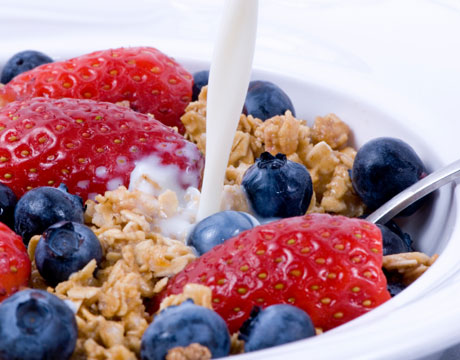
-Whole grain cereal (be careful on this one, a lot of cereals are absolutely LOADED with sugar, read the nutritional label and attempt to find a cereal high in dietary fiber and relatively low in sugar.  Cereal advertising oats, bran and whole wheat is a good place to start.  I would recommend some of Kashi's cereal).

-Whole wheat English muffin

-My personal favorite, and still probably the top contender for the all around BEST breakfast carb:
OATMEAL (and I mean good old rolled oats boiled up in the microwave, not that instant oatmeal.  That stuff is crap, I guarantee you.  Loaded with sugar and artificial flavoring.)

  Oatmeal is piled with complex carbs, or in other words, long lasting energy.  It also has a good amount of protein, and a large amount of dietary fiber.  It's some of the best fuel you could ever put in your body, as far as I'm concerned.  Give it a try, I bet you'll like it as much as I do in no time.

  But just a carbohydrate would be a pretty boring breakfast, eh?  So lets get some protein in there.  And where else but eggs?  Scrambled, fried, made into an omelette, they're all fine choices.  In fact you can go one step further and use cartons of egg whites.  This will take out any bad cholesterol from the yoke, and still be absolutely delicious with a little pepper and cayenne powder.
  You can also get protein from a dairy source, such as milk, or yogurt.  I would suggest skim milk, and greek yogurt, however you can choose what you prefer.  Just make sure to look at the nutrtional label and know what you're getting BEFORE you buy it.  Those sugar loaded yogurts will do you no good in the long run.

  One of my favorite breakfast compliments is a tablespoon or two of either natural peanut butter, or natural almond butter.  Either one is positively delicious on a microwaved bagel, and will give your body the good fats and protein it needs to function.  Give them a try.  For natural peanut butter I would suggest smucker's Natural creamy or chunky.  The only ingredient on the ingredient list is "peanuts".  You can't get much more natural than that.  Just stir the oil back in before usage, and flip the jar over every couple days while it's stored so the oil can float back up into the butter.

  And we can't forget about fruit.  The simple carbs that will get you going for the day.  This is completely your choice here, because nearly any fruit will do the job.  I prefer a banana or apple, but when I'm home from college I usually grab a peach, a plum, a kiwi, or even a mango.  Fruits are packed with nutrients that you need for the day.  You may substitute the fruit with a glass of natural 100% juice, but stay away from concentrates with lots of dye and artificial flavoring.  Just look on the ingredients list.  If you see High Fructose corn syrup, artificial flavor concentrate, and around 6 different dye colors, do yourself a favor and steer clear.

  So this is all fine and dandy, but as always you'll have to make some choices.  A lot of people may be wondering, how many calories should I be eating at breakfast?  While that's an impossible question to generalize, I will say this:  Breakfast should be the big meal of the day, as it will be your main energy source.  As a weightlifter I aim for 700 calories.  That may be a little bit over what you might want, but maybe not by much.  A good range to shoot for is around 400-500 calories.  And if you're still hungry, have another plum.  Your body needs this energy.

  And here's my final word.  Do not, I repeat DO NOT skip breakfast.  You may think it will help you lose weight.  It will do the EXACT OPPOSITE.  It will slow your metabolism down, make you extremely hungry later in the day, send your body into a starvation mode, and in general will make you feel like absolute crap.  Eat a healthy breakfast and I guarantee you'll feel better, look better, perform better, and even make a good first step toward losing those unwanted pounds, or gaining that much desired muscle.

Wake up and eat, my friends.