Showing posts with label wheat. Show all posts

Thursday, February 9, 2012

All About Gluten


Upon walking down the grocery store aisles, you may have come across several foods that are "gluten free."  They're not uncommon to see, and that simple phrase often finds its way onto cracker boxes, breads, soups, and all sorts of other products.  You may even have heard the phrase "gluten intolerant," and may know someone who has this condition.  But chances are, you're not really sure what gluten actually is, where it comes from, what it does, and why some people can't digest it.  Well, hopefully this article will clear things up, and you'll be able to look at those kinds of foods with a new sense of knowledge and understanding.  Hey, you might even try a few.

Gluten, unfortunately, is a pretty complicated substance.  It's what's called a "composite," and is made up of several different proteins.  It's usually found in wheat products, though there's a whole list of other grains that gluten can be found in, including rye, semolina, and barley.  If you're at all interested, the specific proteins found in gluten are: albumins, globulins, gletlins, and prolamins.  Pretty fancy names eh?  In the most basic terms, gluten is just another piece of the puzzle when it comes to grains.  It's just nature...right?

Gluten is usually used as an additive in the food industry to add texture to bread products, like crusts, muffins, or crackers.  Gluten can make things chewy and more substantial, "firmer" in a certain sense.  This makes it extremely useful for all sorts of baked goods.  Gluten is also an excellent protein source, containing about 23 g per quarter cup.  It's also an excellent source of iron.


So why take it out of food?  Why are there such huge advocates of gluten-free diets?  Is the stuff secretly bad for you?  How could it be?  It's just part of grains, and grains are healthy...right?  Well, the good news is that gluten isn't as bad for you as certain people make it out to be.  In fact, as mentioned above, gluten can be quite healthy in certain regards.  However, there is a good percentage of people that can't digest gluten, and suffer from what's called "gluten intolerance."

While this could come about from a wheat allergy, the most common form of gluten intolerance is a disease called celiac disease.  This disease isn't a fun one (not that any disease really is...), and basically prevents your body from absorbing the nutrients normally obtained through food.  How does it manifest itself?  Well, of all things, gluten is the culprit.  For people with celiac disease, consumed gluten actually damages the small intestine through a malfunctioning auto-immune response to the gluten itself.  Your body basically attacks its own intestines, and damages their abilities to absorb nutrients.  Not good.  Not good at all.

People who suffer from celiac disease, or another form of gluten intolerance, have to go on what are called gluten free diets.  These diets aren't easy, and used to be ridiculously restrictive (because so many things contain gluten), but the food options for gluten intolerant individuals are gradually increasing.  Generally all one has to do to find a gluten free variety of their favorite food is to look a little harder on the grocery store shelves. Most companies produce a gluten free variety of their popular products.

So what are the symptoms of gluten intolerance/celiac disease?


Celiac Disease Symptoms In Adults:


Celiac Disease Symptoms In Children:

  • Abdominal pain
  • Abdominal distention
  • Bloating
  • Constipation
  • Intermittent diarrhea
  • Malodorous flatulence
  • Weight loss
  • Vomiting
  • Delayed growth, stunted growth or Failure to Thrive
  • Grayish stools with a foul odor
  • Dermatitis Herpetiformis
  • Urticaria

Those are two lists I pulled off of the first reference listed.  Now many are common occurrences with all sorts of diseases, so you'll definitely want to talk to your doctor about whether or not you may be gluten intolerant.  

But is gluten itself bad?  No, it isn't.  It's just certain bodies can't digest it, and in turn those people become very malnourished and sick quite quickly, without any real obvious reason.  Even people with extremely healthy diets can become quite sickly if they are unknowingly gluten intolerant.  I may suggest trying out a gluten free diet if you're experiencing a few of these symptoms.  Who knows, it may help.

So hopefully you now know a little more about gluten, its composition, its role in our bodies, and how it affects certain people.  Now you can look at those gluten free packages and know exactly what's up.  Cool...right?

GOOD LUCK!

References:

Wednesday, February 8, 2012

Flatout! Multigrain Flatbread *Review*


It's not often you come across a food that's a remarkable step forward in terms of health, convenience, price, and taste.  However, I have to share with you a recent find of mine that I came across in my local Walmart when buying food to stock up my dorm room.  I was looking for whole wheat bagels, and instead came across a brightly colored flat plastic package proclaiming "Flatout!"  Intrigued, I picked it up.  And after reading the front, back, fine print, nutritional information, AND ingredients, I immediately tossed the package in my cart and have been thoroughly enjoying its contents for about a week now.

So what did the package contain?  Well, Flatout makes healthy flatbread/tortillas/wraps, and I've always been a HUGE fan of making wraps containing all sorts of delicious meats and veggies.  They taste amazing, and Flatout flatbreads are NO exception.  I bought their multigrain variety, which not only contains Flax seed and Omega-3 fatty acids, but is made from 100% whole wheat bread.  WOW!  Now that's some serious health horsepower.  But upon reading into the nutritional information and macro-nutrients a little more, the story just gets even better.

What else do these flatbreads have going for them?  Hmmm...where do I begin?

These things are packed with fiber!  Every flatbread has 17 grams of complex carbohydrates, 8 entire grams of which is fiber!  8 WHOLE GRAMS!  That's a LOT of fiber, and is a fantastic addition to any diet.

Not only are you getting a very manageable dose of some of the healthiest carbs you can find, but you'll also get a great dose of protein!  Each flatbread has 9 grams of protein!  Yet again, I say WOW!  That is quite a bit of protein for just one little wrap.  So far I'm loving it.

Also, Flatout flatbreads have only 1 g of sugar per serving, and 2.5 g of unsaturated fat (no saturated fat!  NICE!).  The flax seed adds a whole bunch of Omega-3 as well, which just about everyone needs in their diet. Put some tuna in one of these wraps and you'll be getting enough Omega-3 EFAs to keep your heart happy and healthy for quite some time.

But Flatout flatbreads don't only impress me with what they contain, they also cause great excitement for what they DON'T have.  What am I talking about?  Well in many 100% whole wheat products these days, you'll find that hidden killer, high fructose corn syrup.  That stuff is the devil, and will add fat to your bones quicker than you can get to the nearest dumbbell.  Flatout flatbreads though have none of this, as well as no other crazy, unpronounceable ingredients.  Only the good stuff goes into these breads, and that's just plain awesome.

And did I mention they're only 100 calories EACH!?!

Here are the nutritional facts for Flatout flatbreads:


 Needless to say, I love these things.  They're easy to make into all sorts of amazing culinary creations.  Some days, for a quick and healthy in-dorm breakfast, I make a simple wrap that contains:

1 Flatout! Multigrain flatbread wrap (100 calories)
1 cup of Southwestern style egg beaters (aproximately 110 calories)
3 White button mushrooms (sliced with mandolin) (15-20 calories)
Whatever other veggies I feel like throwing in (would love some diced onions or peppers!)

I basically slice the veggies into the egg whites, stir it up, add some cayenne pepper, and cook it for about two minutes.  I then scoop out the mix onto a Flatout! flatbread wrap, twirl it up nice and tight, and I've got a high protein, low carb breakfast for low calorie days.  Not to mention it's DELICIOUS!

But that recipe is ridiculously simple compared to some of the stuff they have on their site.  Check this out:

Photo of Arugula Mushroom Flatout Thin Crust Pizza


Arugula Mushroom Flatout Thin Crust Pizza
Posted in Grillin' Pizza
1 Flatout® Light Flatbread
1/2 cup fresh, sliced and steamed mushrooms – shiitake, button or portabella
2 Tbs onion, sliced
6 grape tomatoes
1 Tbs olive oil
1 1/2 tsp fat free balsamic vinegar
Salt and freshly ground pepper to taste
1/2 cup baby arugula
1 Tbs freshly grated Parmesan cheese

Preheat outdoor grill. While grill heats, toss mushrooms, onions and grape tomatoes with olive oil; season to taste with salt and freshly ground pepper. Saute 6 to 8 minutes. Lightly oil both sides of Flatout. Cook Flatout on closed grill for 2 minutes. Remove from grill and top with arugula, sautéed vegetables, Parmesan cheese and drizzle with balsamic vinegar. Cut into slices and enjoy!
Alternate Cooking Options: Cook lightly oiled Flatout in 350°F oven directly on grate for 7 minutes. Remove, top with arugula, sautéed vegetables, Parmesan cheese and drizzle with balsamic vinegar. Cut into slices and enjoy!


Does that look good or what?  Check out some other fantastic recipes right on their site:
http://www.flatoutbread.com/category/recipes/

All in all, these wraps are fantastic, a real slam dunk in the diet world.  They're made with quality ingredients, are extremely healthy, and taste absolutely fabulous.  They're moist, thick, and flavorful, and boy do they go great with almost anything.  My rating?  An easy 10/10.  PICK SOME UP TODAY!!!!

Oh, and tell them the Food Guru sent you.  Good Luck!


Tuesday, January 31, 2012

"Naturally More" Peanut Butter *Review*


I couldn't resist, I just had to review another peanut butter.  And before you go clicking away to some other online place, let me tell you this:  This peanut butter might just be the healthiest peanut butter out there on the market today, combining everything necessary to build muscle and stay lean and fit?  Would that grab your interest?  What if I told you that this miraculous peanut butter also had some of the best taste and texture I've ever experienced in any sort of nut butter EVER?  Well if you're wondering what the heck I'm talking about, let me at last relieve your curiosity.

The peanut butter of which I speak is called "Naturally More," and it proudly boasts the slogan "The way Peanut Butter Should Be."  After trying this stuff the very first time, I tend to agree.  This stuff IS the way peanut butter should be.  It's a formula of perfection, at least in my opinion.

What makes this stuff so great?  Well, they started with a natural peanut butter base (good start, healthy monounsaturated fats and nutrient dense), and added everything that PB tended to lack in terms of health factors.  Peanut butter in general isn't a very good protein source, as it's not very protein dense AND most of the protein in peanuts is incomplete (unusable by the body for muscle repair) in its natural form.  Naturally More peanut butter fixed this, and added egg whites to the butter itself.  This bumps up the protein to 10g per serving, a good 30-40% MORE protein than just plain peanut butter!  And you can bet that the protein in Naturally More is a lot more bioavailable to the body, having a more complete nature.


But Naturally More didn't stop there.  They also noticed that while peanut butter itself had a remarkable amount of monounsaturated healthy fats, great for heart health and cholesterol, it was lacking what your body really needs, which are essential fatty acids (EFA's) like omega-3 and omega-6.  They easily solved this dilemma by adding both flax seed and flax oil, two substances extremely rich in EFA's.  But they didn't stop there.  Peanut oil itself has a good amount of omega-6 in it already, and most people consume PLENTY of omega-6 already, therefore Naturally More didn't only add flax oil, they removed most of the peanut oil in favor of a more beneficial omega-3 to omega-6 EFA ratio.  This ratio is very crucial to maintaining health (and a trim figure), and it's another reason why this peanut butter RULES!

Oh, and because it's a natural peanut butter, it has no hydrogenated oils that would produce trans fat.  NO TRANS FAT!!!

Naturally More still wasn't quite done though, and realized that the final category that good ol' natural peanut butter was lacking in, was the fiber department.  Traditionally peanut butter usually has about 1 gram or less of fiber per serving.  Naturally More decided that this wasn't enough, and added wheat germ to their product to increase the fiber count to 2 grams per serving.  Now I know that doesn't sound like a huge jump, but one more gram of fiber can definitely make a difference.  The wheat germ also adds a little more protein, making the overall protein profile more varied.  Nice!

Finally, Naturally More added a little bit of honey in there to replace a good amount of added sugar with natural sugars.  As such, Naturally More only has 3 grams of sugar per serving, a very low overall simple carb count.  There is a slight bit of processed sugar added, which is my only beef with this amazing peanut butter.  At only a few grams though, I don't expect it to ruin anyone's diet.

Here are the nutritional facts for Naturally More Peanut Butter:


Now, for the taste.  I personally think this peanut butter is some of the best I've ever tasted, EVER.  It's rich, creamy, soft, powerful, aromatic, and completely satiating.  I take a tablespoon for breakfast after my whey loaded oatmeal, and always have to just sit back for a minute and just enjoy the amazing flavors coursing through my mouth.  It tastes like a cheat meal, but it's very far from that.  It's hard to believe something so good can be so healthy.

But does it taste like peanut butter?  Well, actually, not exclusively.  Don't get me wrong, the peanut taste is there (in force!) but it's strongly complimented by other flavors, especially that of the flax seed oil, with a slight crunch from the flax seed itself.  I can also taste the wheat germ to a slight degree.  Now I personally LOVE these tastes, and in my opinion they only make the stuff more enjoyable.  But I won't be surprised if this is one of those "love it or hate it" foods.  Some people would die to have another spoonful, others would rather die before forcing it in their mouths.  But that's absolutely NO reason not to try it.  I bet if you try, you'll love it.  I hope you believe me when I say that this stuff is like heaven in a jar, that for once is actually good for you.

What would I rate this peanut butter?

Taste: 9.5/10 


Nutritional profile 9.999/10 (if only there wasn't that tiny bit of added sugar)

Cost value 8/10 (this stuff is pretty cheap, but there are cheaper varieties)

All in all I would definitely, definitely, DEFINITELY recommend trying some Naturally More.  It's got all the right ingredients, an incredible fresh taste, and huge potential to keep you healthy and strong for a long time.  Give it a try!

Seriously, flax-oil, egg whites, and peanut butter?  That seems too good to be true.  GOOD LUCK!

Tuesday, January 10, 2012

Protein Bioavailability List

I mentioned the bioavailability of protein in my last article entitled "Cook Those Eggs."  It occurred to me, why not post a list regarding the bioavailibilty of common proteins you regularly encounter in everyday life?  It's interesting and useful diet information, that's for sure.


Protein Source
BV
Whey Protein Isolate Blends
Whey Concentrate (Lactalbumin)
Whole Egg
Cow's Milk
Egg White (Albumin)
Fish
Beef
Chicken
Casein (a protein from milk)
Rice
Soy
Wheat
Beans
Peanuts
100-159
104
100
91
88
83
80
79
77
74
59
54
49
43

Just to explain the list slightly, those numbers represent the percentage of protein in each food that can be absorbed by the body.  The top two proteins (whey concentrate and whey isolate) are greater than 100% because they are hydrolized, or "pre-digested" to be absorbed by the body more efficiently than almost any other protein type.  There's a reason protein powder costs so much!

If you're looking for this information, I got it from an article whose Google source I will provide:

webpages.charter.net/edsouza/WLS/Proteinseminarpaper.doc

Sunday, October 16, 2011

Breakfast: What You Should Have, And Why

Breakfast is the most important meal of the day.  There is no denying it.  This post will explain what you should have when you finally decide to crawl out of bed, why you should have it, and how it'll help you.


Why?  Because your body has been starving for 8 hours up until breakfast.  It's in a catabolic state (muscle fibers are deteriorating) right until it gets that next little bit of food.  The longer your body is in this state, the more essential muscle fiber you will lose, and the more your metabolism will decrease.  An early breakfast can help reverse this state quickly and kick your metabolism into high gear.

Breakfast will also be the meal your body depends on most throughout the day for energy.  So the pressure's on to make this meal your best (if you're going to choose just one).  But what can you eat that will ensure your body a good start to the day, and in turn produce a great feeling that'll keep you smiling and awake as the hours roll by?

A good place to start is with a good helping of natural, complex carbohydrates.  These will feed your body all day, and give you lasting energy, not to mention your muscles will get constant fuel.  For your carbs, you have lots of options.

You could have:

-Two slices of whole wheat toast

-A whole wheat bagel

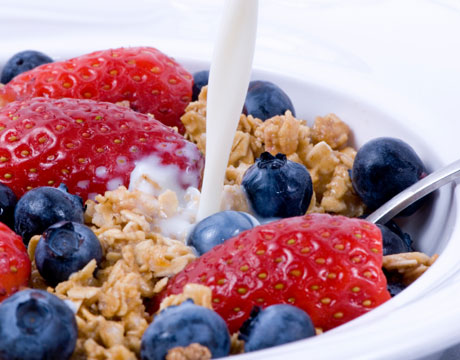
-Whole grain cereal (be careful on this one, a lot of cereals are absolutely LOADED with sugar, read the nutritional label and attempt to find a cereal high in dietary fiber and relatively low in sugar.  Cereal advertising oats, bran and whole wheat is a good place to start.  I would recommend some of Kashi's cereal).

-Whole wheat English muffin

-My personal favorite, and still probably the top contender for the all around BEST breakfast carb:
OATMEAL (and I mean good old rolled oats boiled up in the microwave, not that instant oatmeal.  That stuff is crap, I guarantee you.  Loaded with sugar and artificial flavoring.)

  Oatmeal is piled with complex carbs, or in other words, long lasting energy.  It also has a good amount of protein, and a large amount of dietary fiber.  It's some of the best fuel you could ever put in your body, as far as I'm concerned.  Give it a try, I bet you'll like it as much as I do in no time.

  But just a carbohydrate would be a pretty boring breakfast, eh?  So lets get some protein in there.  And where else but eggs?  Scrambled, fried, made into an omelette, they're all fine choices.  In fact you can go one step further and use cartons of egg whites.  This will take out any bad cholesterol from the yoke, and still be absolutely delicious with a little pepper and cayenne powder.
  You can also get protein from a dairy source, such as milk, or yogurt.  I would suggest skim milk, and greek yogurt, however you can choose what you prefer.  Just make sure to look at the nutrtional label and know what you're getting BEFORE you buy it.  Those sugar loaded yogurts will do you no good in the long run.

  One of my favorite breakfast compliments is a tablespoon or two of either natural peanut butter, or natural almond butter.  Either one is positively delicious on a microwaved bagel, and will give your body the good fats and protein it needs to function.  Give them a try.  For natural peanut butter I would suggest smucker's Natural creamy or chunky.  The only ingredient on the ingredient list is "peanuts".  You can't get much more natural than that.  Just stir the oil back in before usage, and flip the jar over every couple days while it's stored so the oil can float back up into the butter.

  And we can't forget about fruit.  The simple carbs that will get you going for the day.  This is completely your choice here, because nearly any fruit will do the job.  I prefer a banana or apple, but when I'm home from college I usually grab a peach, a plum, a kiwi, or even a mango.  Fruits are packed with nutrients that you need for the day.  You may substitute the fruit with a glass of natural 100% juice, but stay away from concentrates with lots of dye and artificial flavoring.  Just look on the ingredients list.  If you see High Fructose corn syrup, artificial flavor concentrate, and around 6 different dye colors, do yourself a favor and steer clear.

  So this is all fine and dandy, but as always you'll have to make some choices.  A lot of people may be wondering, how many calories should I be eating at breakfast?  While that's an impossible question to generalize, I will say this:  Breakfast should be the big meal of the day, as it will be your main energy source.  As a weightlifter I aim for 700 calories.  That may be a little bit over what you might want, but maybe not by much.  A good range to shoot for is around 400-500 calories.  And if you're still hungry, have another plum.  Your body needs this energy.

  And here's my final word.  Do not, I repeat DO NOT skip breakfast.  You may think it will help you lose weight.  It will do the EXACT OPPOSITE.  It will slow your metabolism down, make you extremely hungry later in the day, send your body into a starvation mode, and in general will make you feel like absolute crap.  Eat a healthy breakfast and I guarantee you'll feel better, look better, perform better, and even make a good first step toward losing those unwanted pounds, or gaining that much desired muscle.

Wake up and eat, my friends.